Navigating the Future of Government IT – Key Takeaways
Overview
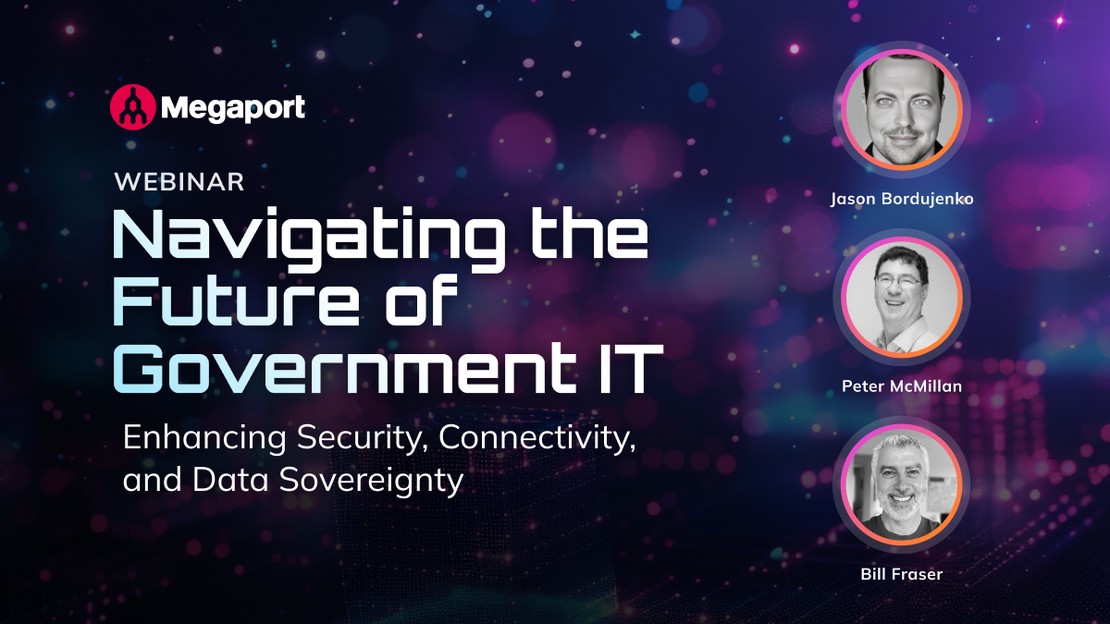
The Navigating the Future of Government IT webinar, hosted by Public Sector Network and sponsored by Megaport, explored how government agencies can modernize IT infrastructure while maintaining security, compliance, and sovereignty.
Speakers included Bill Fraser (Megaport), Peter McMillan (NSW Department of Customer Service), and Jason Bordagenko (Megaport).
The discussion focused on multi-cloud strategies, Zero Trust security, data sovereignty, and balancing innovation with regulation.
1. The Evolving IT Landscape
Governments are rapidly moving from legacy on-prem systems to hybrid and multi-cloud environments. This change is driven by growing data demands, public expectations, and the need for transparency.
Bill Fraser emphasized that technology is now a strategic function, not just a technical one. Agencies must build infrastructures that are adaptable, secure, and scalable to support ongoing digital transformation.
2. Data Sovereignty and Control
Peter McMillan stressed that data sovereignty—keeping data within Australian jurisdiction—is critical. Agencies must ensure data is hosted and transmitted domestically, that providers comply with local laws, and that encryption and access controls meet government standards.
Jason Bordagenko added that it’s not enough to know where data is stored; agencies must also know how it travels. Data in motion and at rest must remain within trusted zones. His guidance: “Trust but verify.” Regular vendor audits, network tracing, and encryption validation are vital for compliance.
3. Security and Zero Trust
Jason described Zero Trust as the new standard for government networks—no connection or user is trusted by default. Principles include continuous authentication, micro-segmentation, and full encryption.
Peter linked Zero Trust to privacy governance, noting that governments must be transparent about how citizen data is used. Security frameworks must align with both ethical and legal standards, ensuring that AI-driven systems remain accountable and privacy-respecting.
4. Connectivity and Resilience
Government IT environments now span on-premises data centers, cloud providers, and SaaS platforms. Megaport’s Network-as-a-Service (NaaS) simplifies this by enabling private, programmable connectivity between multiple environments without physical cross-connects.
This flexibility supports rapid provisioning, testing environments, and temporary projects—cutting deployment times from weeks to minutes.
Jason outlined redundancy strategies like active-active load balancing, active-passive failover, and pilot-light recovery setups.
Peter underscored the importance of dual-path connectivity to ensure uptime, especially during outages or cyber incidents.
5. Innovation and Cost Efficiency
Agencies often face the challenge of innovating while staying within budget. Megaport’s elastic connectivity model allows for short-term testing and scalable growth without committing to costly long-term contracts.
Peter emphasized that agile innovation improves citizen services, while Jason highlighted cost transparency—monitoring cloud use, reducing idle resources, and using multi-cloud models to avoid vendor lock-in.
Dynamic provisioning ensures spending aligns with demand, giving agencies both flexibility and fiscal control.
6. Automation, AI, and Workforce Skills
Jason emphasized automation through infrastructure-as-code tools like Terraform to standardize configurations and minimize manual errors. Automated deployment also speeds up recovery, rebuilding systems in minutes after disruptions.
AI and machine learning enhance observability, identifying anomalies and optimizing performance before failures occur.
Despite automation, human expertise remains crucial. Governments must invest in cybersecurity talent to interpret, refine, and secure these systems effectively.
7. Policy Alignment and Proof of Concept
During Q&A, the speakers discussed policy alignment and proof-of-concept (POC) programs. Megaport’s pay-as-you-go model allows agencies to run pilots before full implementation—supporting agile procurement and measurable outcomes.
Peter cited the NSW Government’s Secure Inter-Agency Network—built on Zero Trust, MACsec encryption, and Internet Exchange integration—as an example of scalable, secure collaboration across departments.
8. Future Outlook
Governments must create IT systems that are secure, sovereign, and adaptable. The path forward rests on five key principles:
- Sovereignty – Keep data under national control.
- Security – Enforce Zero Trust and encryption everywhere.
- Resilience – Design redundancy and disaster recovery into all systems.
- Agility – Enable on-demand provisioning and flexible scaling.
- Innovation – Leverage automation and AI to enhance service delivery.
Cross-agency collaboration and clear governance will define success. Future-ready government IT demands both adaptability and responsibility—ensuring that digital progress strengthens, rather than risks, public trust.
Conclusion
Modernization is not just about adopting new technology—it’s about responsible digital governance. Public trust depends on secure, reliable, and transparent systems.
Megaport’s NaaS model exemplifies how governments can achieve scalable, secure, and flexible digital infrastructure.
The future of government IT is multi-cloud, sovereign, and citizen-focused—a balance of agility, security, and integrity.