



Resource Center
Everything Megaport.
And more.
Whether you’re just discovering us, or a returning pro, there is always something new happening at Megaport.
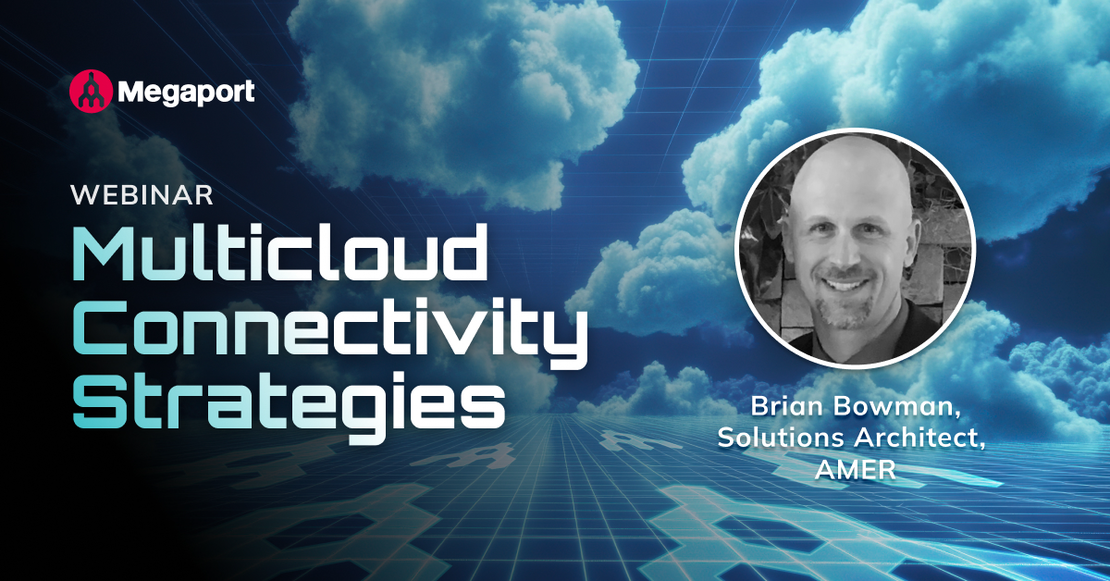
Multicloud Connectivity Strategies
Walk away with clear insights on how to simplify your network, reduce risk, and improve agility, without compromising performance.
In this recording, you’ll see:
- Why 86% of enterprises are already multicloud
- How to avoid vendor lock-in and reduce egress fees
- Key paths to multicloud: DC, branch, and ecosystem strategies
- Virtual routing and firewall use cases that cut complexity
- A live demo of a scalable, cloud-agnostic architecture
Need help with simplifying your multicloud network?
With a Megaport Solutions Architect
Find out how to connect your business in 60 seconds.
We’ve helped hundreds of customers, just like you, to simplify their connectivity.
Multicloud Connectivity Strategies – Key Takeaways
Overview
The Multicloud Connectivity Strategies webinar, hosted by Megaport Solutions Architects Brian Bowman and Dan Pfyl, explored how enterprises design, evolve, and optimize multicloud networking. The session covered adoption trends, design best practices, live demonstrations in the Megaport Portal, and a Q&A addressing practical deployment challenges.
The central theme: organizations are moving from single-cloud dependency to intentional multicloud architectures that maximize flexibility, performance, and resilience while minimizing cost and vendor lock-in.
1. Multicloud Adoption and Market Reality
Bowman began by framing the current landscape: 93% of enterprises use multicloud, operating across an average of 4–5 different clouds.
Drivers include:
- Vendor flexibility: avoiding dependence on a single hyperscaler.
- Performance optimization: placing workloads where they perform best.
- Compliance and sovereignty: keeping data in jurisdictional boundaries.
- Resilience: spreading workloads across clouds reduces single points of failure.
New industry-specific providers (e.g., healthcare, finance, GPU, and storage-focused clouds) are expanding options beyond AWS, Azure, and Google Cloud. This diversification reinforces the need for network architectures that connect everything securely and efficiently.
2. Benefits and Strategic Motivations
Multicloud adoption provides organizations with:
- Strategic leverage: access to the best tools from multiple vendors.
- Cost and performance optimization: ability to shift workloads for pricing or latency advantages.
- Enhanced resilience: redundancy across platforms ensures business continuity.
- Compliance alignment: local data storage supports regulatory obligations and sovereignty laws.
By contrast, single-cloud strategies often create vendor lock-in and restrict flexibility in pricing, architecture, and innovation cycles.
3. Challenges in Multicloud Networking
The benefits of multicloud come with complexity. Bowman outlined several common challenges:
- Cloud silos: Teams specialize in different clouds, leading to fragmented management and duplicated effort.
- Inconsistent security models: Separate policies across providers introduce risk.
- Shadow IT: Departments may deploy unapproved solutions.
- IP overlap: Especially common during mergers or multi-region operations.
- DIY VPN networking: Overreliance on ad-hoc VPN tunnels creates fragile, hard-to-maintain infrastructure.
Pfyl and Bowman stressed the need for centralized visibility, standardization, and automated policy enforcement across cloud environments.
4. Design Considerations and Best Practices
When planning multicloud connectivity, key architectural decisions include:
- Defining business requirements: performance, uptime, and latency expectations.
- Security levels: determining when to use private circuits, encryption, or overlays.
- Cost vs. criticality: balancing uptime requirements with budget.
- Virtualization: adopting network function virtualization (NFV) for agility and lifecycle simplicity.
- Future readiness: designing for integration with niche or future cloud providers.
Bowman emphasized that the network is the backbone of hybrid and multicloud. Applications and databases distributed across different clouds demand predictable, secure, and low-latency connectivity.
5. Architecture Evolution — The Enterprise Journey
Megaport illustrated the evolution of enterprise networks:
- Legacy MPLS: Centralized data centers hosting compute and storage.
- Hybrid Cloud: Private connections from data centers to public clouds.
- Virtual Routing (Megaport Cloud Router – MCR): Enables direct cloud-to-cloud routing without backhauling through data centers.
- Network Function Virtualization (Megaport Virtual Edge – MVE): Integrates SD-WAN and virtual firewalls for secure, distributed edge connectivity.
- Cloud-Only Architecture: Virtualized, cloud-native routing without physical data centers.
This “enterprise journey” shows how organizations can incrementally evolve toward agile, software-defined connectivity.
6. The Megaport Solution
Megaport’s Network-as-a-Service (NaaS) platform simplifies multicloud networking by providing:
- Ports in over 1,000 global data centers.
- Virtual cross-connects (VXC): private, on-demand links between locations and clouds.
- Megaport Cloud Router (MCR): virtual routing between AWS, Azure, GCP, Oracle, and more.
- Megaport Virtual Edge (MVE): deploys SD-WAN and security appliances at the edge.
This eliminates the need for physical infrastructure, reducing provisioning time from weeks to minutes. Customers can connect multiple clouds privately, automate routing, and deploy BYOL firewalls (e.g., Fortinet) in Megaport’s environment for unified security across cloud domains.
7. Demonstration Summary
In the live demo, Bowman demonstrated how to:
- Deploy an MCR near cloud regions (e.g., Ashburn, Virginia).
- Establish redundant connections between AWS and GCP using Partner Interconnect.
- Use the Megaport Portal to automate provisioning, configure BGP sessions, and view learned routes.
- Add virtual firewalls and route filters directly in the platform.
The demonstration showcased how quickly enterprises can extend existing environments into new clouds — without new hardware or long lead times.
8. Q&A Highlights
- Connecting Private Data Centers: Most customers use 10Gb waves or Ethernet private lines to reach Megaport-enabled facilities.
- Prefix Filtering: Supported on MCR for precise route control and security.
- Firewall Integration: Customers can deploy licensed firewalls (e.g., Fortinet) in Megaport’s virtual environment.
- Cost Optimization: Choose carrier-rich facilities to lower local loop expenses.
Pfyl and Bowman emphasized collaboration with Megaport architects to ensure efficient deployment, redundancy, and cost-effective routing design.
9. Key Takeaways
- Multicloud is now mainstream. Nearly every enterprise runs workloads across multiple platforms.
- Private, virtualized interconnects outperform public internet VPNs in reliability, performance, and security.
- Automation and NFV reduce operational overhead and enable flexible scaling.
- Megaport Cloud Router provides a foundation for cloud-to-cloud routing and global visibility.
- Edge integration via MVE extends control and security closer to users and applications.
- The future network is software-defined, policy-driven, and cloud-neutral.
Conclusion
The Multicloud Connectivity Strategies webinar demonstrated that the enterprise network is no longer static — it’s dynamic, distributed, and service-driven. Organizations embracing multicloud connectivity must design with resilience, visibility, and agility in mind.
Megaport’s NaaS platform enables that shift by providing the flexible backbone for seamless, private, and secure multicloud interconnection. The key message: the modern network should evolve from infrastructure to intelligence — powering faster innovation, stronger compliance, and greater business control across every cloud environment.