







About Arcor
In its Consumer Food Division, Arcor offers high-quality foods under leading brands you can find in over 100 countries; through its Agribusiness Division, it provides innovative ingredient solutions for various industries; and within its Packaging division, it develops cutting-edge packaging solutions, positioning it as one of the leading companies in the Southern Cone.
Sustainability is at the core of who Arcor is, how it operates, and how it grows. The company produces in harmony with nature, prioritizes the wellbeing of people and the planet, and strives to make a positive impact with every step it takes.
Today, it operates 49 industrial plants and commercial offices across four continents, where more than 20,000 passionate and entrepreneurial people work with a commitment to quality, innovation, and sustainability.
Key Points
- Deployed Megaport Virtual Edge (MVE) running VMware VeloCloud to integrate Arcor’s SD-WAN fabric with Megaport’s global Network as a Service (NaaS) platform.
- Removed dependence on physical infrastructure and third-party rack interventions, replacing with on-demand provisioning via a single portal.
- Used Megaport Internet to create geographic redundancy through dual MVE instances across multiple facilities.
- Built a future-ready architecture that scales to future integrations and multicloud expansion.
Case Study Snapshot
Arcor’s most critical operations run in Oracle Cloud Infrastructure (OCI) in the USA. When the contract for its existing connectivity solution came up for renewal, the team used the opportunity to look for a better alternative.
That legacy setup relied on a patchwork of separate vendor contracts — one for internet connectivity, another to rent rack space in a third-party data center — and, from there, a physical connection into Oracle. Whenever a link went down or performance degraded, it wasn’t easy to fix and left Arcor dependent on third-party providers — directly affecting how reliably users could reach their enterprise services.
Using MVE running VMware VeloCloud, as well as Oracle FastConnect, Arcor replaced its old setup with a fully on-demand platform managed through a single portal, completed in a 10-minute cutover with zero end-user disruption.
“Our goal was not only to improve connectivity, but to build a scalable architecture capable of supporting Arcor’s long-term cloud strategy.”
– Carlos Sercombe, Networking Leader, Arcor
Challenges
As Arcor’s cloud footprint grew, reliable connectivity to its critical workloads became essential to keeping global operations running. These workloads live in Oracle Cloud Infrastructure (OCI) in the United States — and reaching them from Arcor’s sites was becoming harder to sustain.
Because of the connectivity architecture required to integrate its SD-WAN fabric with Oracle Cloud Infrastructure (OCI), Arcor relied on physical equipment in a third-party data center, using a physical connection (Oracle FastConnect) to reach OCI from there. That data center was positioned far from Arcor’s Oracle workloads, so the connection suffered outages and latency that directly affected end-users.
The setup was also rigid and vendor-dependent, stitching together separate contracts — internet connectivity from one provider, rented rack space from another — and every change meant coordinating with an overseas third-party vendor to intervene at the rack. Outages and performance drops were never quick to resolve.
When the contract for that connectivity solution came up for renewal, Arcor took the opportunity to find a dedicated partner that could deliver the same access without the physical footprint and third-party dependency.
Solution
After evaluating traditional telecom providers and direct cloud connectivity models, Megaport stood out to Arcor for its on-demand connectivity, flexible bandwidth scaling, and rapid provisioning.
Arcor decided to build with Megaport, using the global NaaS platform to deliver a full-scale, flexible cloud architecture from Latin America to North America. The entire cutover migration was completed in a 10-minute window, switching from a secondary connection to Megaport with zero disruption to end users.
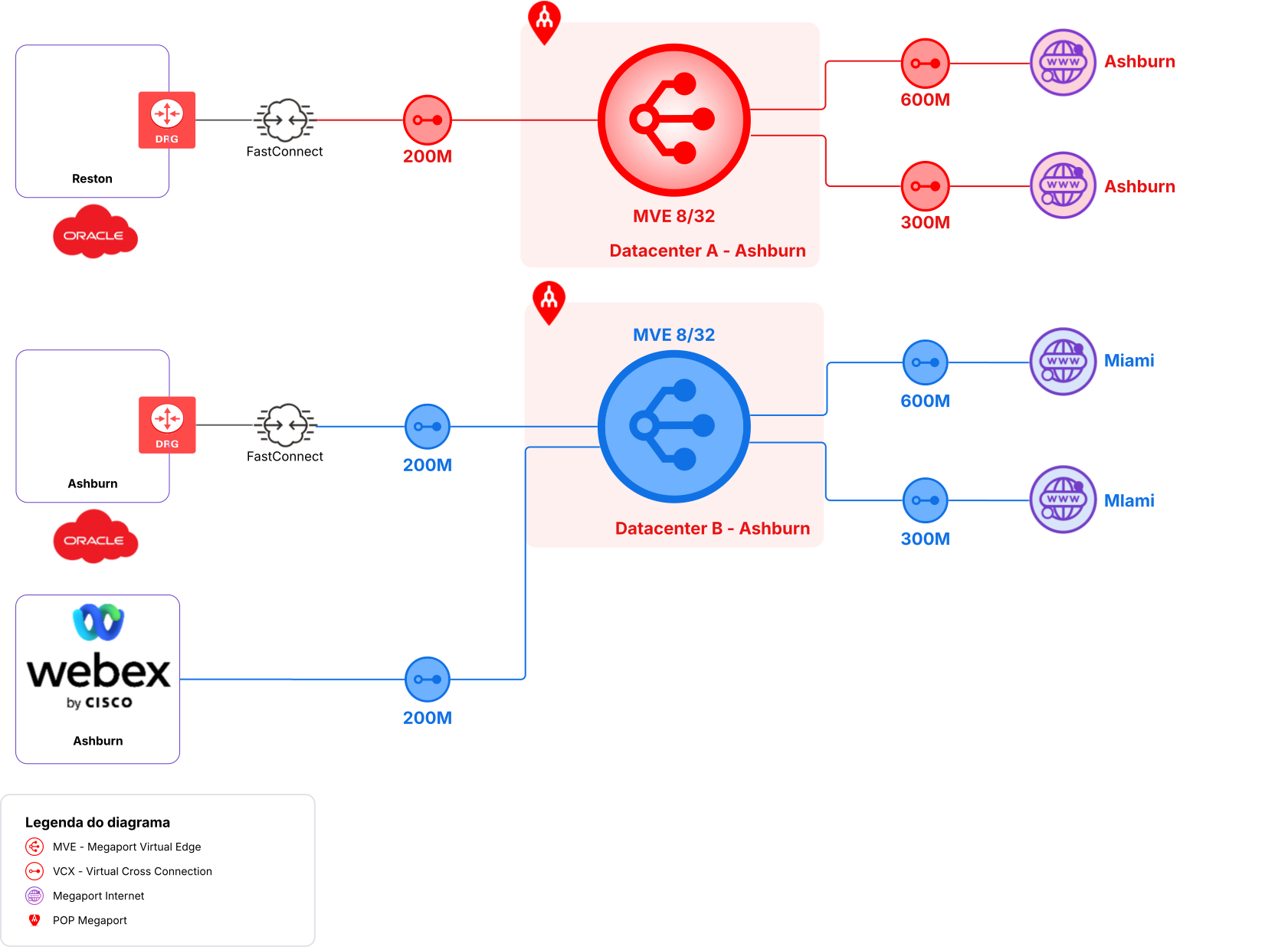
Arcor’s new hybrid architecture includes:
- MVE to run VMware VeloCloud and integrate Arcor’s SD-WAN fabric with Megaport’s global network
- Megaport Internet to create internet clusters in Ashburn and Miami, offering geographic flexibility
- private connectivity to Oracle Cloud Infrastructure using Oracle FastConnect, enabling dedicated and predictable access to cloud resources
- integration with enterprise collaboration services, which is currently in testing as part of Arcor’s next phase of the deployment.
This architecture allows global users to reach US locations and cloud services through a flexible SD-WAN fabric, with more consistent latency, all connected via Megaport’s private interconnection platform.
Benefits
Building with Megaport significantly improved Arcor’s connectivity architecture and cloud access model.
By combining SD-WAN with Megaport’s on-demand private connectivity platform, Arcor has built a modern hybrid cloud connectivity architecture that supports both their current workloads and future digital initiatives.
Simple, virtual networking
Arcor’s virtual private network can now be managed on-demand via a simple portal, eliminating the need for Arcor to deploy and manage physical infrastructure in multiple international data centers.
Happier team
With more predictable and lower latency access to cloud workloads hosted in Oracle Cloud Infrastructure, the Arcor team has improved their user experience and gained full visibility over their costs for more accurate forecasting.
But the biggest IT benefit has been the complete change in how easily the team now administers connections.
“The best part of using Megaport is how it has made our lives easier. Now we can provision and manage our connections easily, and provide reliable work to our users. They can continue working as if nothing has changed, and that’s how we know we’re doing a great job,” said Sercombe.
Performance and resilience
For Arcor, the biggest performance win is the stability this new architecture delivers. The setup now provides geographic redundancy across both the data center and internet connectivity, and Arcor’s connection point to Oracle sits much closer to the workloads — together making the service far more stable than before.
Scalable, future-ready architecture
With access to over 1,000 Megaport-enabled locations globally, Arcor can provision new connections and scale bandwidth on demand with no lead times and no vendor calls. As new services are adopted, the network grows with them.
That flexibility is already being put to work as Arcor tests new use cases to push their architecture even further.
Future Plans
With this new architecture, users in Argentina can now reach cloud services through Arcor’s VeloCloud SD-WAN fabric, which connects directly to cloud environments like OCI via Megaport’s private interconnection platform.
“It’s valuable to be able to test and disconnect quickly with the Megaport Portal. It has made building much easier,” said Sercombe.
Arcor’s current setup is also now poised to grow into a full multicloud solution across Oracle, Google Cloud, and Microsoft Azure — and the team is exploring how else they can integrate the software-defined fabric into their operations.