






What is AWS Cloud WAN? Benefits, Use Cases, and Adoption Best Practices
By Randy Riggs, Network and Cloud Solutions Architect
Learn how AWS Cloud WAN works, key benefits, limitations, use cases, and adoption best practices.
As AWS environments grow across multiple regions and accounts, networking can become increasingly difficult to manage. What starts as a handful of virtual private clouds (VPCs) can quickly evolve into a complex web of connectivity, routing policies, and security requirements.
AWS Cloud WAN was designed to address this challenge by providing a centralized approach to building and operating global networks. Instead of managing networking services and routing configurations independently across regions, organizations can use a single global network architecture with central visibility and policy management.
In this guide, we’ll explain what AWS Cloud WAN is, how it works, its key benefits and limitations, and when organizations should consider adopting it.
What is AWS Cloud WAN?
AWS Cloud WAN is a managed service that simplifies the creation and operation of a global wide area network across multiple AWS Regions and on-premises environments.
Traditionally, organizations connecting workloads across regions and accounts often rely on a combination of VPC peering, AWS Transit Gateway, and custom routing configurations. While effective, these approaches can become difficult to manage as environments scale.
AWS Cloud WAN provides a centralized alternative. It creates a global network backbone that enables consistent connectivity across distributed AWS environments while providing a single control plane for management, visibility, and policy enforcement.
How does AWS Cloud WAN work?
At the center of AWS Cloud WAN is the core network, which acts as a global backbone spanning multiple AWS Regions. This core network is governed by policies that define how traffic is routed, segmented, and secured throughout the environment.
Multiple components work together to deliver this functionality:
Core network
The core network provides the underlying connectivity framework that links AWS resources across regions and accounts.
Segments
Segments allow organizations to logically isolate traffic between environments, applications, or business units. For example, production, development, and testing environments can each operate within separate segments while remaining centrally managed.
Attachments
Attachments connect resources into your Cloud WAN environment. These can include:
- VPCs
- VPN connections
- Direct Connect gateways.
Network function groups
Network function groups allow organizations to direct traffic through security and inspection services, such as firewalls, providing greater control over how traffic flows through the network.
Together, these components are what create AWS Cloud WAN’s centrally managed network architecture, which can scale across regions with consistent connectivity and policy enforcement.
What networking challenges does AWS Cloud WAN solve?
One of the biggest challenges in large AWS environments is managing connectivity across multiple regions and accounts.
Traditional networking approaches often require administrators to configure and maintain multiple networking services independently. As environments grow, routing policies, connectivity requirements, and security controls can become increasingly difficult to standardize.
AWS Cloud WAN addresses these challenges by:
- centralizing network management through a single control plane
- providing consistent connectivity across regions and accounts
- reducing manual configuration through policy-based automation
- improving visibility across the entire network
- simplifying network expansion into new AWS Regions
- supporting logical segmentation for different environments and business units.
This centralized approach can help reduce operational complexity while improving consistency across large-scale AWS deployments.
AWS Cloud WAN vs traditional AWS networking
AWS Cloud WAN is not a replacement for every networking service in AWS, but it offers a different operational model compared to traditional architectures.
Traditional approach | AWS Cloud WAN |
Multiple networking components managed independently | Centralized management through a single control plane |
Separate routing configurations across regions and accounts | Unified policy-driven network management |
Manual deployment and updates | Greater automation capabilities |
Limited end-to-end visibility | Centralized visibility across the network |
Scaling can increase operational complexity | Designed to simplify multi-region growth |
What organizations should use AWS Cloud WAN?
AWS Cloud WAN is particularly well suited for organizations with large, geographically distributed AWS environments, like:
- Multi-region organizations: Companies operating across several geographic regions can simplify connectivity management through a centralized global network.
- Large enterprises: Organizations managing large numbers of VPCs and AWS accounts can benefit from a scalable networking model that simplifies management.
- Organizations with multiple divisions or units: Businesses needing strict network segmentation between departments, applications, or environments can use Cloud WAN segments to maintain isolation while managing everything centrally.
What are the benefits of AWS Cloud WAN?
Faster deployment and management
Cloud WAN can reduce the time required to deploy and manage large AWS environments spanning multiple accounts and regions, with automation capabilities that allow organizations to create and update networking components across regions more efficiently.
Improved visibility
Administrators get centralized insights into connectivity and traffic flows across the network, making monitoring and troubleshooting easier.
Better security and policy management
Central policy enforcement helps organizations apply security controls consistently across regions and network segments.
Network segmentation
Cloud WAN enables traffic isolation between applications, environments, or business units, helping organizations maintain security boundaries while supporting operational requirements.
Improved traffic reliability and performance
AWS Cloud WAN can improve traffic reliability and application performance while simplifying management across complex environments.
Integration with AWS networking services
Cloud WAN integrates with AWS Network Manager, helping organizations coordinate and manage networking services through a unified experience.
What are the limitations of AWS Cloud WAN?
While Cloud WAN offers significant advantages, network managers should also understand its limitations before adoption.
Cost considerations
Charges for core network resources, VPC attachments, processing, and data transfer can increase as environments scale. Cross-region traffic costs can also balloon if not carefully managed.
Operational complexity
Although Cloud WAN centralizes management, multi-region and multi-account environments still require careful planning, governance, and operational expertise. Organizations may also need additional training to build internal Cloud WAN knowledge.
Routing constraints
Network managers should be aware that:
- some routing scenarios may not be supported
- static routes are generally not supported
- Transit Gateway peering is limited to resources within the same region
- ASN conflicts with existing Direct Connect gateways must be avoided.
Technical limitations
Certain scenarios may introduce additional complexity, including:
- certificate-related issues between regions
- incomplete BGP support in some situations
- lack of support for Direct Connect communities.
These considerations should be evaluated during planning and design phases.
How do you successfully adopt AWS Cloud WAN?
Successful AWS Cloud WAN adoption starts with a well-defined strategy.
- Define your core network policy: Your core network policy establishes the foundation for connectivity, segmentation, security, and traffic management.
- Deploy required components: Ensure core networks, segments, attachments, and supporting resources are fully deployed and properly configured.
- Take a phased migration approach: Rather than migrating everything at once, move workloads incrementally and validate connectivity and performance at each stage.
- Continuously monitor and optimize: Ongoing monitoring allows teams to refine policies, improve segmentation strategies, and optimize network performance over time.
How Megaport complements AWS Cloud WAN
For organizations connecting AWS workloads to on-premises environments, connectivity remains a critical part of the overall network architecture.
Megaport-enabled locations connect to AWS using AWS Direct Connect connections – one for each location associated with the AWS Regions where workloads reside. A Transit VIF is deployed on each AWS Direct Connect connection, with unique IP prefixes advertised from each location as shown below.
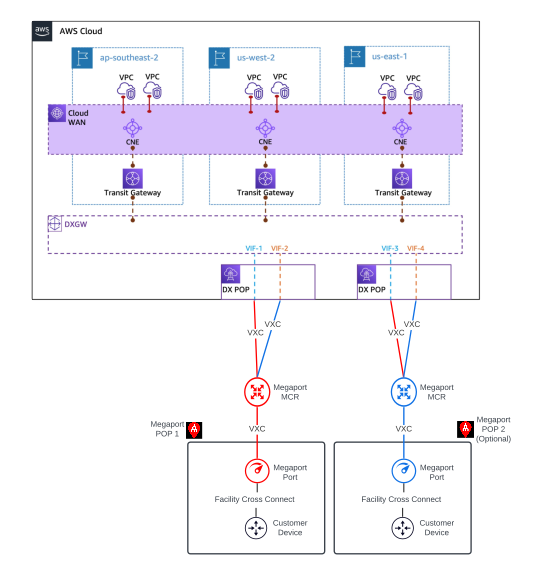
How to deploy AWS Cloud WAN
Once you’ve defined your core network policy and designed your segmentation strategy, deployment typically follows four high-level steps.
1. Create a Megaport Port or Megaport Cloud Router
Establish connectivity to the Megaport network by creating either a Port or a Megaport Cloud Router (MCR).
A Port provides a high-speed interface that enables point-to-point connectivity between your locations and connected service providers, while an MCR provides virtual routing capabilities within the Megaport platform.
2. Create a VXC and configure your AWS connection
Next, create a Virtual Cross Connect (VXC), which provides a Layer 2 Ethernet connection to an AWS on-ramp on the Megaport network.
Once connected, you can configure an AWS Hosted Connection, an AWS Direct Connect service that provides on-demand connectivity over pre-provisioned network circuits.
Learn more about configuring and maintaining AWS hosted connections.
3. Create and configure your AWS VPCs
With connectivity established, create the required VPCs in each AWS Region and connect them to the Transit Gateway.
4. Create and configure AWS Cloud WAN
Finally, deploy AWS Cloud WAN and follow AWS’s instructions to configure the core network, segments, attachments, and policies required to connect your regions and environments.
Learn more from AWS on creating a Cloud WAN global network and core network.
As organizations expand their AWS footprint across regions, combining a well-designed connectivity strategy with AWS Cloud WAN can create a more scalable and centrally managed network architecture.