


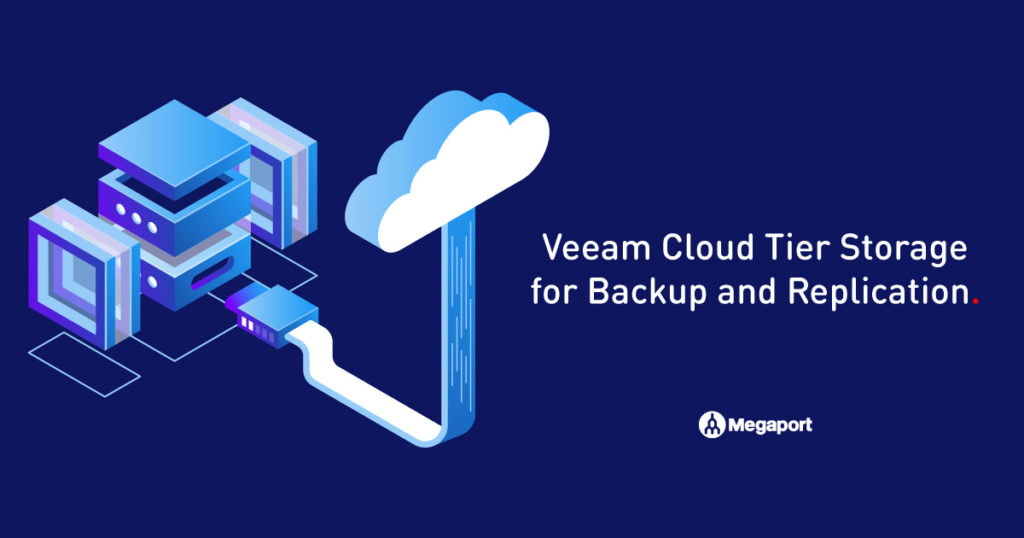
Veeam Cloud Tier Storage for Backup and Replication
- Cloud networking
- February 5, 2019
- RSS Feed
How Veeam and Megaport services enable smart network architectures for backup and replication.
The VeeamON 2018 conference in Chicago brought with it the announcement of a range of new features from Veeam, one of the world’s leading data management providers. These additions centered around the Veeam Backup and Replication 9.5 Update 4 which now has general availability as of 22 January 2019. A major feature that many organisations have been anticipating is Veeam Cloud Tier – a long-term data retention solution that supports cloud storage such as Amazon S3 and Microsoft Azure Blob Storage.
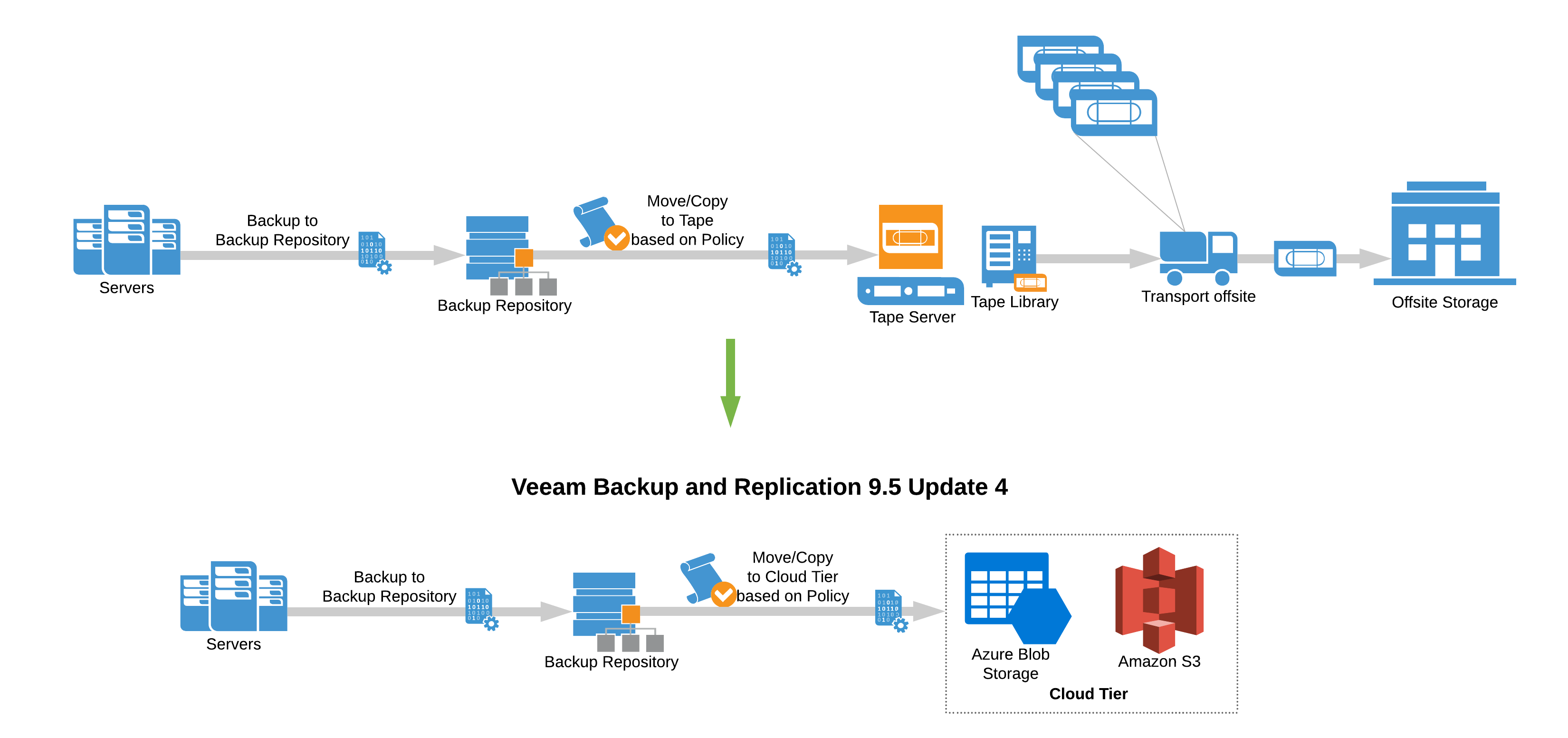
The beauty of Veeam Cloud Tier is that it enables organisations to store archived backups in a highly durable online storage system that is maintained by their chosen cloud provider at a low per-gigabit price delivered over their network. Previously, they’d require traditional archive infrastructure such as tape drives and transport and logistics arrangements to ship and store tapes in a secured location. Our diagram shows the difference between the old manual process and the new Veeam Cloud Tier solution.
Data Transfer Speeds Affecting Archiving
Recovery Point Objective (RPO) and Recovery Time Objective (RTO) can greatly impact business operations. By minimising the time required to transport backups offsite, an organisation can efficiently execute their disaster recovery plan to restore data from backups into cloud environments if an incident occurs.
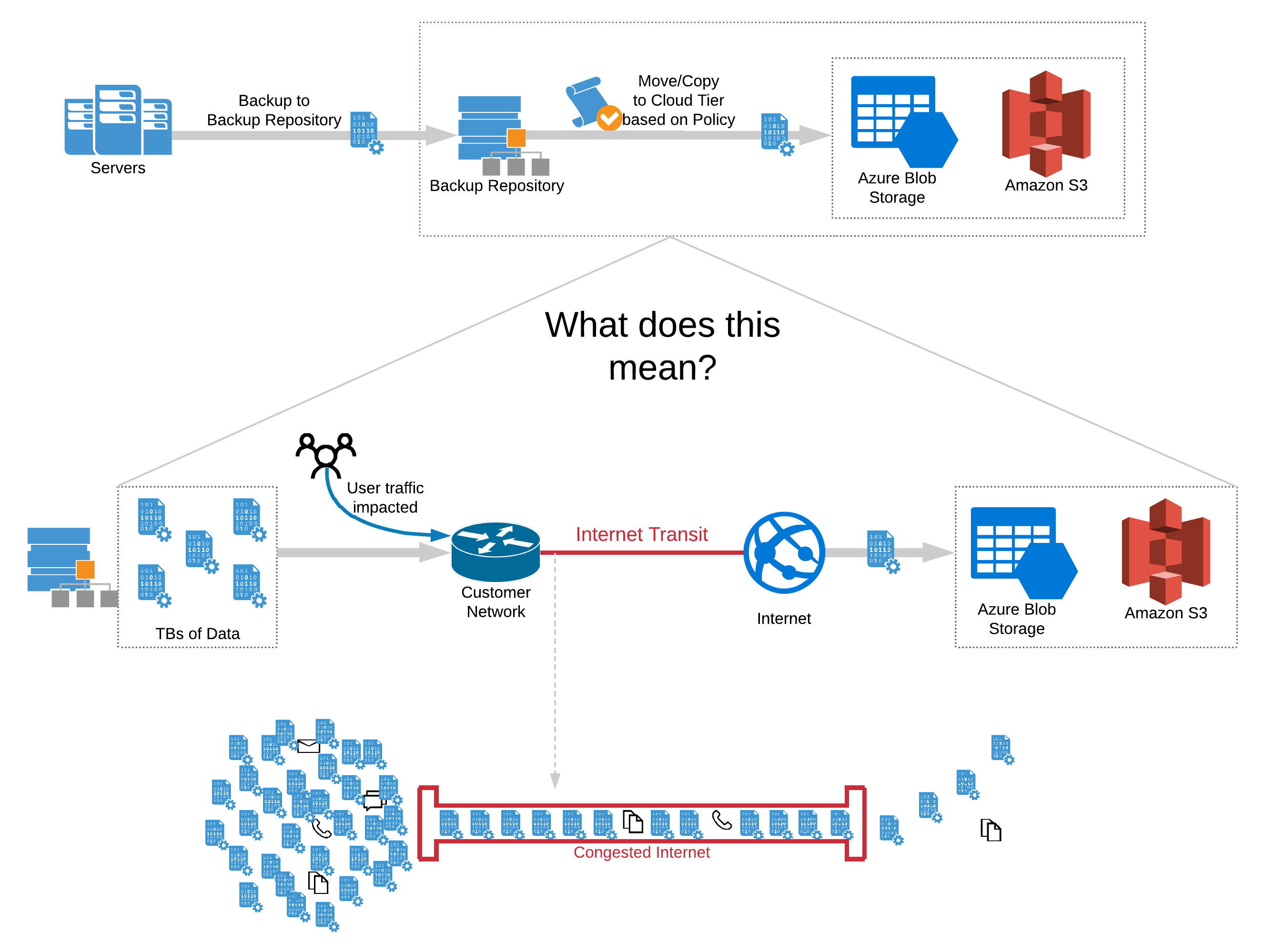
However, the global average data transfer speed collected on Speedtest Global Index for December 2018 was 54Mbps (Down) and 27Mbps (Up). A simple calculation tells us that, on average, businesses will require approximately four days to archive 1TB of data running at 100% utilisation into their cloud storage.
What does this mean for the business? Let’s say the organisation has:
- ~10TB of VMs/DBs/Files to protect
- ~5% daily change rate/growth rate
The differential data to archive would be ~6TB and it would take approximately 24 days for their IP Transit, dedicating 100% bandwidth to backup, to complete their archive per month.
Solving the Bandwidth Issue and Other Challenges
One of the simplest solutions to reducing bandwidth usage and data transfer time is to implement a dedicated connection into the cloud. This might be to Microsoft Azure via ExpressRoute or AWS via Direct Connect. Using a Network as a Service (NaaS) provider like Megaport can enhance this connection and ensure that bandwidth is scalable and able to be dialled up and down depending on needs. Provisioning a connection is near instant with little to no waiting time. NaaS connectivity also gives reachability from global data centres – and from outside of cloud regions. So, establishing Veeam Cloud Tier software across the cloud provider of choice is much easier and faster when leveraging the next-generation technology of NaaS.
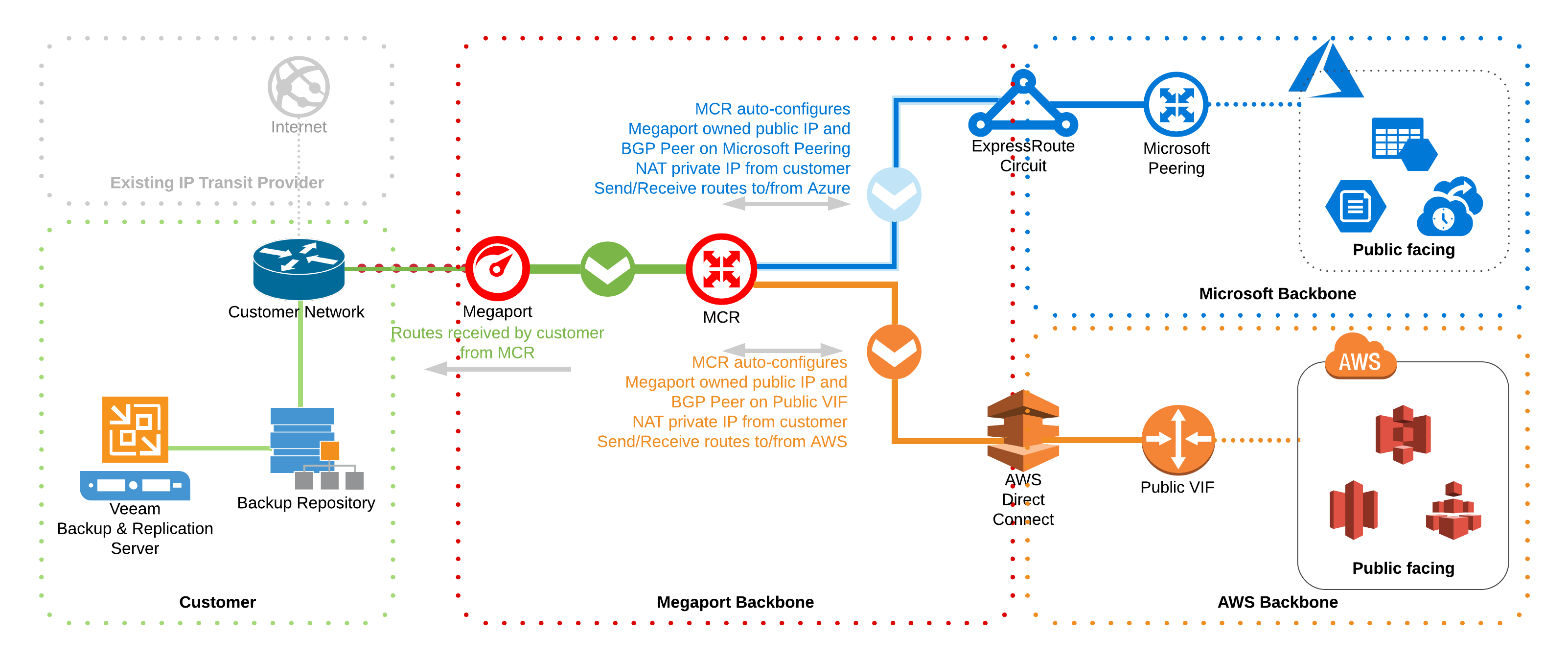
However, not every organisation owns public IP addresses to implement Microsoft Peering over ExpressRoute or Public VIF over AWS Direct Connect. This challenge can be overcome by using Megaport Cloud Router (MCR) which enables virtual routing, allowing customers to use up to 10 public IPs owned by Megaport.
What does a Megaport solution look like?
Scenario 1
Business does not own any public IP or their on-premises infrastructure does not support BGP
Prerequisites
- Customer (on-premises) network equipment supports LX Optical 1Gbps or LR Optical 10Gbps Ports
Megaport Technology Required
How many?
Megaport
1 or (2 in a Link Aggregation/LAG)
Megaport Cloud Router (MCR)
1
Virtual Cross Connect (VXC)
1 to each CSP (Azure and/or AWS) and 1 Private VXC
Scenario 2
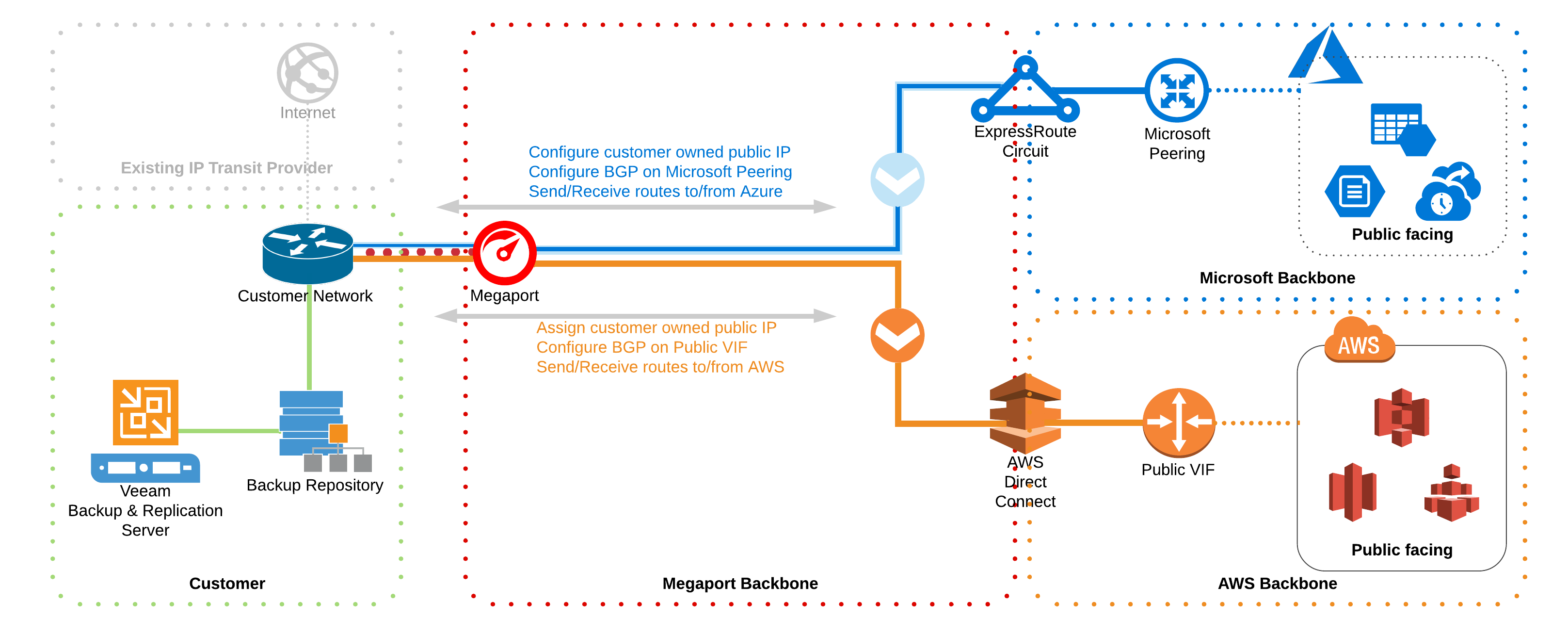
Business owns public IP that can assign and advertise, on-premises infrastructure also supports BGP, and on-premises infrastructure also support IEEE 802.1ad (Q-in-Q)
Prerequisites
- Customer (on-premises) network equipment supports LX Optical 1Gbps or LR Optical 10Gbps Ports
- Customer (on-premises) network equipment supports BGP
- Customer (On-premises) network equipment supports IEEE 802.1ad (Q-in-Q) – Specifically for Azure If 802.1ad not supported, use MCR (Scenario 1)* Customer owns public IP address and AS number that they can advertise via BGP
Megaport Technology Required
How many?
Megaport
1 or (2 in a Link Aggregation/LAG)
Megaport Cloud Router (MCR)
0
Virtual Cross Connect (VXC)
1 to each CSP (Azure and/or AWS)
With digitisation and data storage demands rapidly increasing, ransomware attacks and other factors resulting in the loss of data are also becoming a bigger problem. Fast data transfer is crucial for organisations who want to keep their data secure. With Veeam Cloud Tier software and NaaS services connecting organisations directly to their chosen cloud providers, it’s now easier and faster to achieve smart backup and replication processes.
For more technical solutions with Megaport, visit Megaport Documentation. If you’d like to reach out, feel free to Tweet us.