




IBM Cloud Direct Link 2.0 Aims to Improve Resiliency
- Cloud networking
- March 31, 2022
- RSS Feed
IBM Cloud’s new and improved Direct Link 2.0 comes with a myriad of benefits – and it’s now available on Megaport’s Software Defined Network.
In September 2020, following the onset of the global COVID-19 pandemic, IBM Cloud responded to the changing needs of its customers by launching Direct Link 2.0. This enhanced version of IBM Cloud’s legacy Direct Link was aimed at improving availability and redundancy for customers now fully reliant on a virtual network.
Since then, Direct Link 2.0 has been enhanced to new levels, and Megaport and IBM have now completed a global migration from the legacy Direct Link Connect to Direct Link Connect 2.0. Here’s what this means for IBM and Megaport customers.
The benefits of IBM Cloud Direct Link 2.0
The legacy IBM Cloud Direct Link works by connecting to an Infrastructure as a Service (IaaS) network and global Virtual Routing and Forwarding (VRF). In comparison, Direct Link 2.0 allows connectivity to both the classic IaaS and IBM Cloud Virtual Private Cloud (VPC). Direct Link 2.0 connections now terminate first at the IBM Cloud edge, where access to traditional IaaS or VPCs is streamlined. The Direct Link 1.0 interface will be deprecated at a future date.
Direct Link 2.0 also has multiple BGP enhancements focused on better redundancy and security, including:
- Support for Bidirectional Forwarding Detection (BFD), improving failover convergence time for redundant links
- Implementation of Message Digest 5 (MD5) authentication, improving message security between BGP peers via authentication
- When MD5 is enabled, routing updates via Transmission Control Protocol (TCP) between BGP peers are validated. Please note BGP peers must be configured with the same password for a BGP neighbor relationship to be established.
Dive deeper into IBM Cloud Direct Link’s exciting new features.
Enhanced connectivity with Megaport and Direct Link 2.0
With Megaport and IBM Cloud’s latest integration, customers can now enjoy all the benefits of Direct Link 2.0 on Megaport’s private, global Software Defined Network (SDN). And there are a number of further benefits for joint customers, including:
- Support for multiple VPCs from a single Direct Link connection within the same account
- Improved Bring Your Own IP (BYOIP) address options
- Support for connections to multiple IBM Cloud accounts via VPC from a single Direct Link
- Metered billing options
- Improved inventory views with visibility of router diversity scenarios
- Reduced latency and increased availability
- Reduced data egress costs
- Secure connectivity
Learn more about Megaport’s integration with IBM Cloud here.
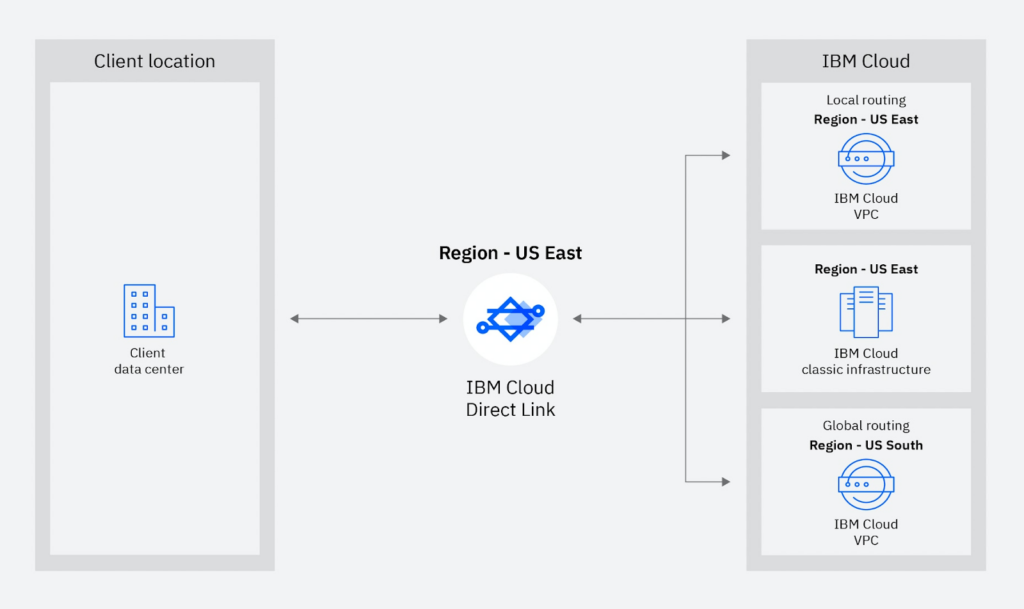
Direct Link 2.0 is supported by Megaport at the following IBM Cloud Direct Link service locations:
Europe
- Amsterdam
- Frankfurt
- London
- Paris
North America
- Ashburn
- Chicago
- Dallas
- San Jose
- Toronto
Asia-Pacific
- Tokyo
- Osaka
- Sydney.

Megaport is a key Direct Link partner with global connectivity
presence in our MZRs (multi-zone regions).
Providing DL 2.0 through Megaport enables our clients to
reach their IBM Cloud workloads with the speed and
reliability they deserve."
Gilberto Tellez, Networking Product Manager
Get started with Megaport and IBM Cloud Direct Link 2.0
When connecting to IBM through a Direct Link with Megaport, you’ll need a Virtual Cross Connect (VXC) as this forms the Layer 2 component of your connection. Your Layer 3 BGP connectivity is then established directly with IBM Cloud.
To set up IBM Direct Link with Megaport, you’ll first need to create the Direct Link Connect in the IBM console, then create a VXC from your Port to the IBM Direct Link cloud location.
Setting up IBM Direct Link with Megaport also gives you several options for customizing your redundancy, routing, and port speed.
Learn more about connection options and find more detailed step-by-step guides for using Megaport with Direct Link 2.0 in the Megaport Docs Portal.
- Find “Connecting to IBM Cloud Direct Link 2.0” here.
- Find “Creating MCR Connections to IBM Cloud Direct Link 2.0” here.
Direct Link 2.0 ports are identified in the portal as shown below:
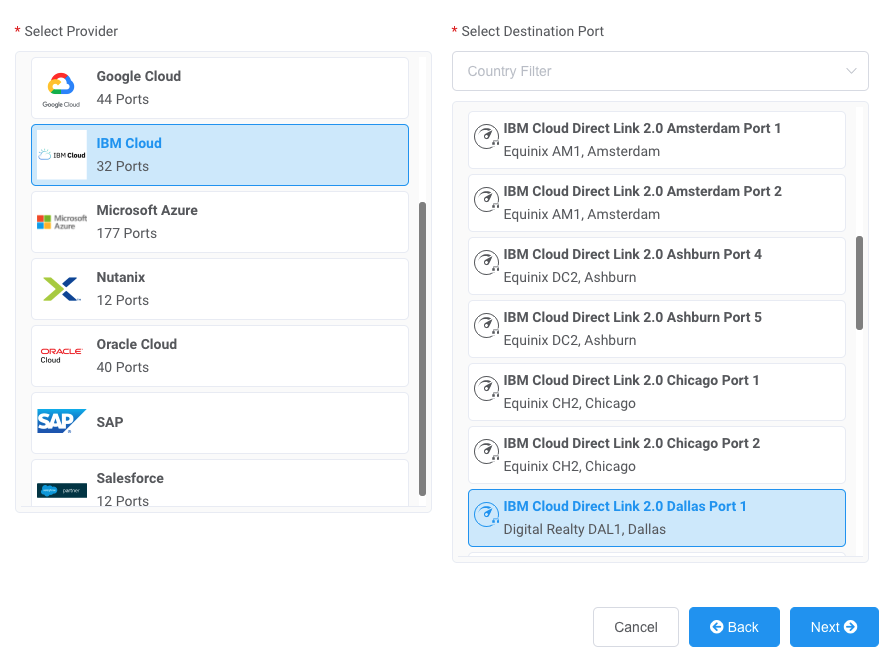
Learn more about setting up Megaport and IBM in IBM Cloud Docs.
Have more questions or need help setting up IBM Cloud Direct Link 2.0 with Megaport? Get in touch with us here.
Stay Updated
Keep up to date on Megaport in the news by following us on social media at:
Twitter: @megaportnetwork
LinkedIn: @megaport
Facebook: @megaportnetworks