




Launching Self-Service LAG Ports
- Cloud networking , News
- March 28, 2019
- RSS Feed
How Link Aggregation Group (LAG) Ports enable you to build right-sized resilient networks with greater control over capacity and throughput.
With more data moving to the cloud and between public and private infrastructure than ever before, enterprise businesses are searching for optimised ways of migrating large workloads. Gaining greater control and choice over network connectivity is key to achieving this – and these factors play a major role in building resilient, future-proofed network architectures.
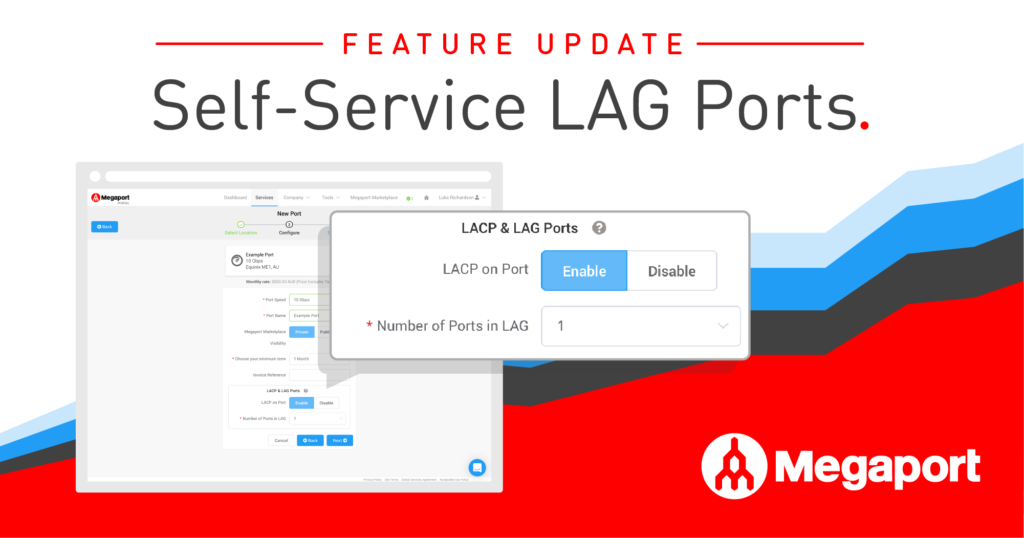
We’re launching LAG Ports as an available feature on the Megaport Network to provide customers with more options for their network connectivity. LAG Ports give you the capability of aggregating Ports – and combining connections together – to enable increased throughput, right-sized networking, and the benefit of balancing traffic across links simultaneously for redundancy.
For example, when connecting to service providers, or implementing a Data Centre Interconnect (DCI) strategy, with Megaport, you can now combine a 10Gbps Port with another 10Gbps Port in parallel to enable 20Gbps in capacity to the IX in the same metropolitan area.
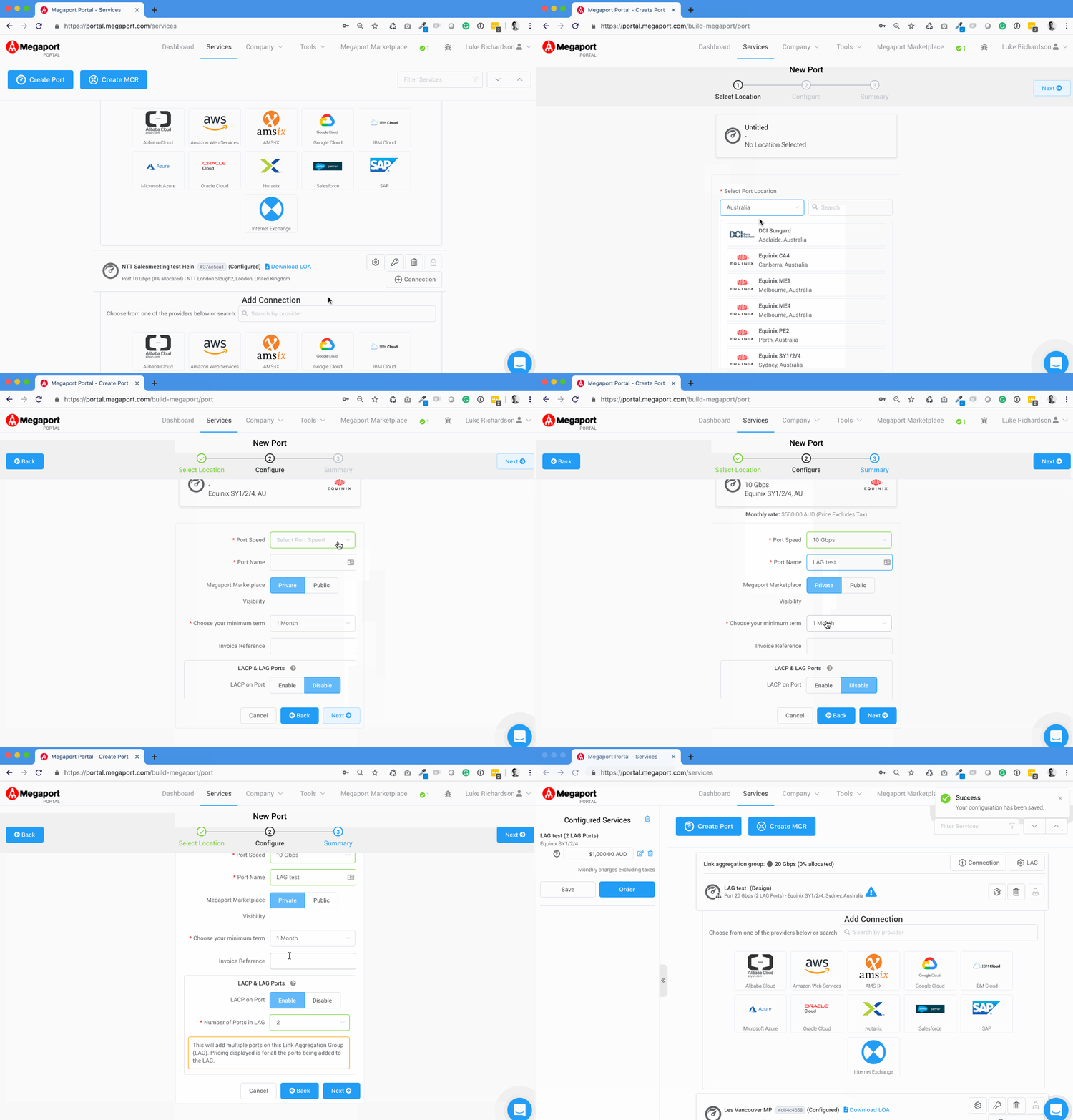
Applying LAG Ports to your network architecture with Megaport unlocks powerful use cases for your business by providing you with the choice and control to:
- Build a streamlined redundant network design by reducing Single Points of Failure (SPOFs) in bringing multiple links into one dynamic network - where if one link goes down - you can rely on the others to automatically take the workload.
- Scale your network and peer larger amounts of traffic between your private infrastructure and service providers with greater capacity than previously enabled.
- Create a resilient network that is right-sized; be more prescriptive with your connection sizes and avoid costly upgrades to get your required bandwidth.
- Easily achieve the above by instantly provisioning LAG Ports and connections in your self-service Megaport account.
With these capabilities, it’s now easier and faster to set up network connectivity that enables your business to streamline day to day operations as well as think (and act) ahead of time to provide the resilience and capacity you might need in the future.
For more information on setting up, and creating an optimised network architecture, with LAG Ports, visit Megaport Documentation.