





The Internet is a Series of Tubes: Peering and the MegaIX
- October 6, 2017
- RSS Feed
Share and source traffic with a global network of service providers via the MegaIX.
Peering via an Internet Exchange (IX) is an effective measure for businesses to source and share content across global networks. Large-scale providers have dominated the IX space up until recent times and now, enterprises are leveraging IX services to quickly and easily access and distribute data as business demands grow. Megaport’s MegaIX provides the infrastructure and Ecosystem to make peering practical and accessible to broader markets. Our global Software Defined Network (SDN) allows our customers to build tailored connectivity solutions to solve business-critical challenges.
The benefits of an IX
There are significant benefits in choosing peering over transit; we are frequently asked, “How does IX content differ from a full internet feed?” In reality, an IX doesn’t contain a route to every destination on the internet. However, peering via an IX can reduce costs, increase performance, and ensure a stable and reliable network for traffic. Megaport offers a high-bandwidth express lane to the most frequently accessed connectivity networks in the world. This means bypassing traditional layers of networks-upon-networks, and getting directly in touch with a local cache, or sourcing/delivering traffic directly from/to a partner’s worldwide private content delivery network (CDN). The leading networks available on the MegaIX include: Cloudflare, Netflix, AARNet, Microsoft, Akamai, Fastly Inc, Verizon Digital Media Services, Softlayer, Apple, and Limelight Networks. Local content and peers can vary in city-to-city availability.
Common types of peering arrangements
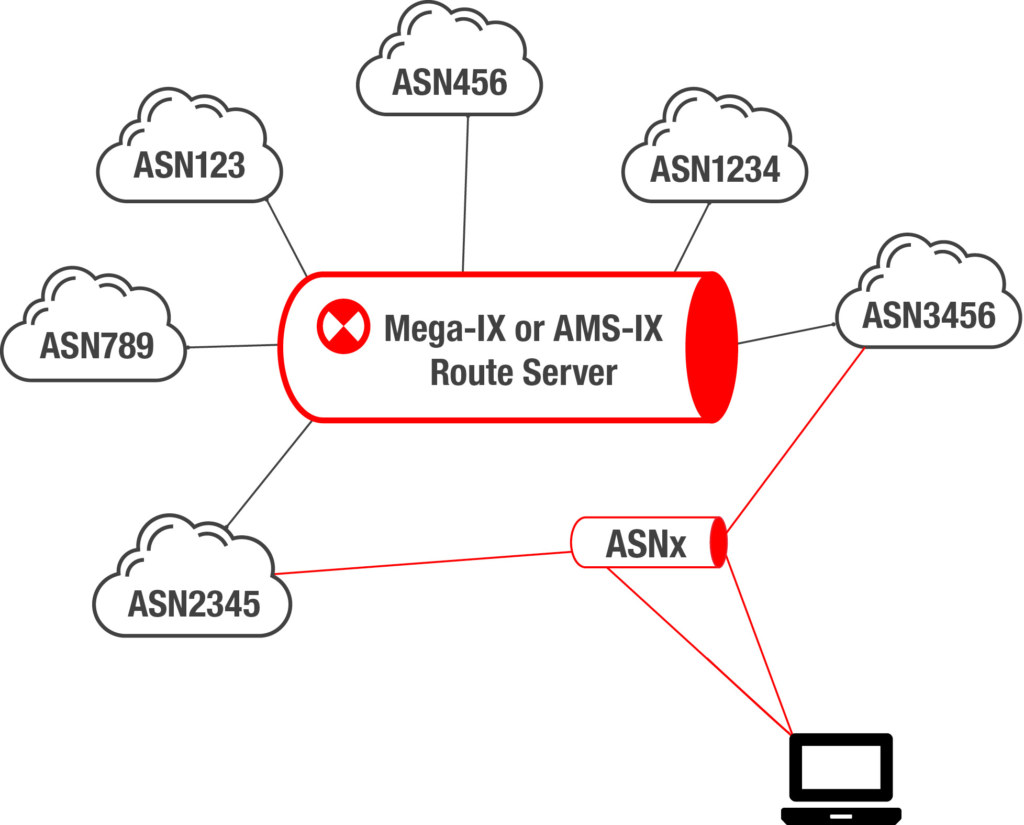
Two connectivity types define the scope and environment of peering: private and public. In addition, multilateral and bilateral peering describe the types of available peering agreements; these terms indicate the commercial arrangements into which peers enter. Private peering is generally reserved for a two-way exchange of large volumes (multiple gigabits per second) of content between two parties who find mutual benefit. This exchange is costly because each peer usually requires a separate router or switch port. Connectivity between these routers is also required; this might come in the form of a cross-connect in a co-located data centre, or a long distance telecommunications provider circuit, if the two parties are in different facilities. Public peering, on the other hand, functions by running IX route servers at the common MegaIX meet-me locations. Route servers facilitate multilateral peering whereby each peer can connect with all other peers who use that route server. There is no need to build a direct peering session to each individual party on the IX or update any peering/routing information when a new peer on-boards to a given IX location. When connecting to the MegaIX, customers instantly access a shared distributed switching infrastructure that is capable of high-speed interconnection. To put this into perspective, some of our busiest exchange occurs over 150 networks. This would take extensive configuration for engineers to setup and maintain if they don’t make use of the route servers. It’s not necessary to participate by connecting to the route servers (a pair of high availability servers deployed at geographically redundant but well-connected locations). However, by doing so, some networks may choose to mix it up and use both route servers for the bulk of the peers and also direct BGP sessions for special networks.
How to participate in peering on the MegaIX
Requirements:
- Own BGP ASN, typically allocated by an RIR (APNIC in the Asia Pacific region)
- At least a /24 of multi-homed/able IPv4 address space, or a /48 of IPv6 address space
- A router capable and licensed (if required) for BGP with a Megaport physical connection already established or able to be established
For more information on peering via the MegaIX, please complete the form below. Check out our latest blog post on direct connectivity here.