






How to Get Higher Network Availability
- Cloud networking
- July 28, 2026
- RSS Feed
Reduce downtime and build a more resilient network with our practical tips for improving network availability.
By Serena Toh and Matt Madawi
Table of Contents
Network availability is more than a technical metric (though it is an important one). The availability of your network is the difference between applications that keep serving customers and applications that stall when a link, device, data center, or provider fails.
For network managers, the goal is to design a network that expects failure, contains the blast radius, and recovers fast enough that users and applications feel little to no disruption. This is exactly what a high availability network is built to do. It uses redundancy, diverse paths, dynamic routing, monitoring, and disciplined change control to reduce single points of failure and improve network uptime.
What is a high availability network?
A high availability (HA) network is designed to maintain service even when individual components fail. Instead of relying on one router, circuit, data center, or cloud on-ramp, HA architecture uses redundant components and automated failover so traffic can keep moving.
The most resilient designs remove single points of failure across the full path: from the customer edge, through transport, and into the cloud, data center, or service provider edge. That means thinking beyond simple device redundancy and looking at physical diversity, geographic diversity, routing behavior, power, monitoring, and operational process.
A network needs several features to be considered high availability.
- No single point of failure: Critical components are duplicated across devices, links, power, and locations so one failed component does not take down the entire service.
- Physical path diversity: Primary and secondary paths avoid sharing the same vulnerable facilities, conduits, or points of presence where possible, reducing the risk that one fiber cut or facility issue affects every path.
- Device diversity: Connections terminate on separate physical routers, switches, or cloud/provider devices to protect against hardware failure and maintenance events.
- Geographic diversity: Connectivity spans multiple data centers, availability zones, metros, or regions to limit the impact of localized outages, power events, and natural disasters.
- Dynamic routing and fast failover: Protocols such as BGP, often paired with Bidirectional Forwarding Detection (BFD), detect failure and reroute traffic to keep applications reachable without manual intervention.
- Monitoring and alerting: Teams track health, traffic, latency, jitter, packet loss, logs, and service events so problems are detected earlier and resolved faster.
Network availability targets: what the nines mean
Availability targets vary by application and industry. A customer-facing payment platform, for example, needs a more aggressive uptime target than a non-critical internal tool. To achieve high availability for your organization, choose the target first, then design the architecture and operational processes to match it.
Availability target | Approximate downtime per year | Common use case |
99.9% | 8 hours 46 minutes | Important internal services |
99.99% | 52 minutes 36 seconds | Business-critical applications |
99.999% | 5 minutes 15 seconds | Mission-critical platforms such as payments, trading, and telecom services |
Quick wins to improve network availability
Improving availability doesn’t always require a complete redesign. These quick wins can materially reduce outage risk while giving teams a stronger foundation for longer-term HA architecture improvements.
Remove obvious single points of failure
Start by auditing critical paths for single devices, circuits, power feeds, cloud on-ramps, and data center dependencies. This is often the fastest way to reduce outage exposure.
Redundant equipment still needs independent paths, power, and termination points. Otherwise, it can look resilient on paper while still depending on the same vulnerable component.
Use physically diverse connectivity
Deploy primary and secondary paths that avoid shared facilities and common points of failure where possible. A backup path is only useful if it is not affected by the same incident as the primary path.
Confirm diversity with providers instead of assuming different circuits are truly diverse.
Enable BFD with BGP where supported
Use BFD alongside BGP on cloud links, WAN uplinks, data center interconnects, and standby paths. BFD can detect link failure much faster than relying on default BGP timers alone.
Tune timers carefully and validate behavior before production rollout.
Use private connectivity for critical cloud traffic
Move critical cloud connectivity away from best-effort internet paths where private connectivity is available. Private paths can provide more predictable performance, lower exposure to internet congestion, and stronger operational control.
Design redundant private paths; one private circuit can still be a single point of failure.
Tighten monitoring and alerting
Track port, circuit, VXC, device, latency, jitter, packet loss, and bandwidth usage, then send alerts to incident channels. This helps teams identify degradation before it becomes a full outage.
And don’t monitor only up/down status – performance degradation matters too.
Review change management
Document changes, back up configurations, test failover, and avoid unreviewed production changes. Many outages are caused by preventable configuration or change errors.
Redundancy can fail silently if it is misconfigured or never tested.
High availability architecture patterns that improve network uptime
The right HA architecture depends on where the highest risk sits in your network: campus LAN, data center fabric, internet edge, cloud connectivity, or branch connectivity. Many organizations need more than one pattern.
Architecture pattern | How it works | Best for | Availability benefit |
Dual-homing with technologies such as vPC, VSS, or MEC | A downstream device connects to two physical upstream switches that act as one logical pair. | Campus LANs, server access, and top-of-rack designs. | Provides link and node redundancy without relying on a slow spanning-tree recovery event. |
Leaf-spine data center fabric | Every leaf switch connects to every spine switch, often using ECMP to spread traffic across paths. | High-performance data centers and cloud-style environments. | If one spine fails, reachability remains and capacity is reduced rather than fully lost. |
Multi-homed BGP with provider diversity | The edge connects to two or more providers and uses BGP to reroute traffic if one path fails. | Internet edge, corporate headquarters, and web-facing applications. | Protects against provider outages and upstream path failures. |
Multi-region cloud connectivity | Connections terminate into multiple cloud on-ramps, availability zones, metros, or regions. | Cloud and multicloud environments. | Reduces dependency on a single facility, region, or cloud edge. |
Redundant virtual routing or SD-WAN edge | Virtual routers or edge appliances are deployed in diverse locations or zones. | Branch, cloud, and hybrid network connectivity. | Improves continuity when an appliance, link, or site becomes unavailable. |
Monitoring approaches that help maintain high network availability
A resilient network needs to be maintained after it’s built. Monitoring, observability, logging, and automation help teams detect degradation, understand root cause, and respond before users are affected.
Infrastructure monitoring
- What to monitor: Device health, CPU, memory, interface status, port status, bandwidth, uptime, and errors.
- Why it matters: Shows when known network components are failing or approaching capacity.
Performance monitoring
- What to monitor: Latency, jitter, packet loss, throughput, queueing, and congestion.
- Why it matters: Reveals degradation that up/down monitoring can miss.
Application observability
- What to monitor: Application response times, request success rates, workload patterns, and dependency health.
- Why it matters: Connects network behavior to the user and application experience.
Centralized logging and SIEM
- What to monitor: Network events, configuration changes, security events, system logs, and service notifications.
- Why it matters: Helps teams correlate events and reduce time to resolution.
Synthetic and path analysis
- What to monitor: End-to-end path health across internet, private, cloud, and branch routes.
- Why it matters: Shows whether traffic is taking the path expected and where degradation is occurring.
Automation and API integrations
- What to monitor: Thresholds, failover events, service status, provisioning workflows, and alert routing.
- Why it matters: Enables faster response and can support automated remediation where appropriate.
Within Megaport environments, teams can use the Megaport Portal to monitor service status, port and VXC health, bandwidth usage, and service notifications. For deeper integration, the Megaport API can be used to pull service data into monitoring platforms, dashboards, alerting workflows, or automation pipelines.
Common mistakes that reduce network availability
Assuming redundancy equals availability
Having two links does not automatically make a network highly available. Those links might still share the same physical path, device, building, provider dependency, power source, or cloud on-ramp.
Validate end-to-end diversity across devices, facilities, providers, power, and cloud access points.
Monitoring only up/down status
A link can be technically up while latency, jitter, packet loss, or congestion still hurts the application experience.
Monitor performance and user-impacting indicators, not just whether a service is up or down.
Weak change management
Unreviewed changes, missing backups, and undocumented configuration edits can create avoidable outages.
Use approvals, version control, backups, rollback plans, and maintenance windows to reduce the risk of preventable failures.
Untested failover
Backup paths may not carry traffic correctly when the primary path fails. Redundancy is only useful if it works under real failure conditions.
Schedule controlled failover tests and validate routing, capacity, and application behavior before you need the backup path in production.
Poor capacity planning
New cloud applications, video traffic, AI workloads, backups, and IoT growth can exhaust links faster than expected.
Track usage trends and plan upgrades before congestion becomes a business problem.
Misconfigured routing or VLANs
BGP, VLAN, failover, or route preference errors can break redundancy during the moment it is needed most.
Peer review configurations and test failure scenarios before go-live.
How Megaport can support high availability network design
Megaport helps teams build more resilient hybrid cloud and multicloud networks by making it easier to deploy redundant private connections across data centers, cloud regions, and service provider locations.
Instead of relying on a single connection, single facility, or single cloud on-ramp, organizations can use Megaport to design for diversity across the full network path. That might mean connecting from different data centers, using separate Megaport Ports, routing through different cloud on-ramps, or using virtual routing and edge services to avoid unnecessary dependence on one physical location.
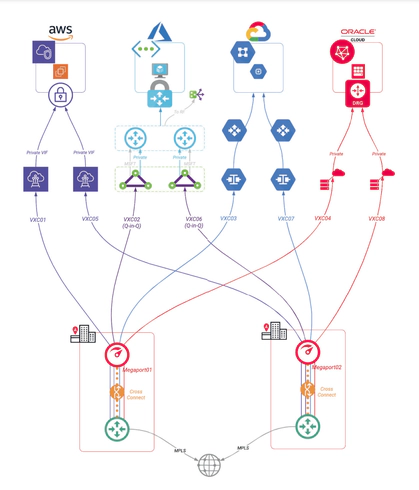
Port diversity
Port diversity is a strong starting point for improving network availability. By connecting from separate physical locations, teams can reduce the risk that a single data center issue, device failure, or access path disruption affects all cloud connectivity. This is especially useful for organizations connecting on-premises environments into one or more cloud providers.
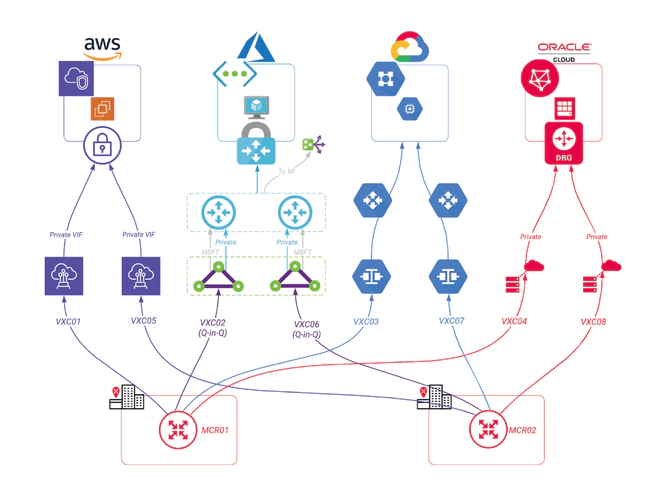
Megaport Cloud Router diversity
For organizations building cloud-to-cloud or multicloud environments, Megaport Cloud Router (MCR) can also support high availability designs without requiring traffic to route back through on-premises infrastructure. This can help reduce complexity and avoid unnecessary hairpinning when applications, data, or services need to move between cloud environments.
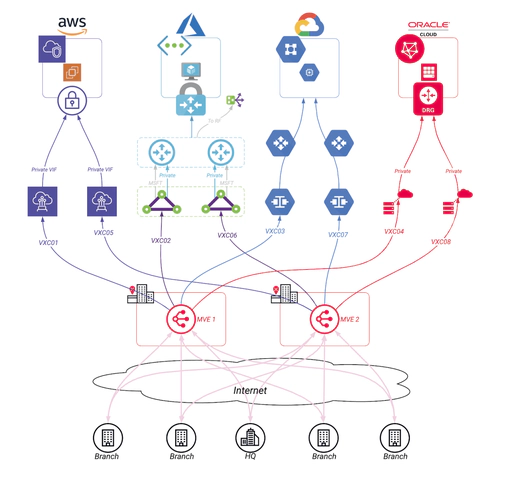
Megaport Virtual Edge diversity
For distributed environments, Megaport Virtual Edge (MVE) can support resilient branch-to-cloud connectivity. This is useful when organizations need to connect branch locations, cloud environments, and virtual network functions through diverse Megaport-enabled locations.
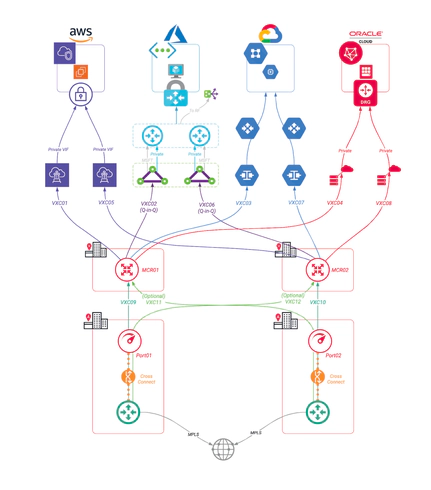
Port diversity and MCR diversity
These designs can also be combined. For example, an organization might use Port diversity to connect its on-premises infrastructure into Megaport, then use MCR diversity to create resilient private connectivity between multiple cloud providers. This creates a stronger hybrid and multicloud architecture because both the on-premises access layer and the cloud-to-cloud routing layer are designed with redundancy in mind.
Port diversity and MVE diversity
For branch-heavy environments, Port diversity and MVE diversity can also be combined to help branch traffic move through separate locations and paths. This can improve resilience for distributed users, cloud-hosted applications, and SD-WAN-style architectures.
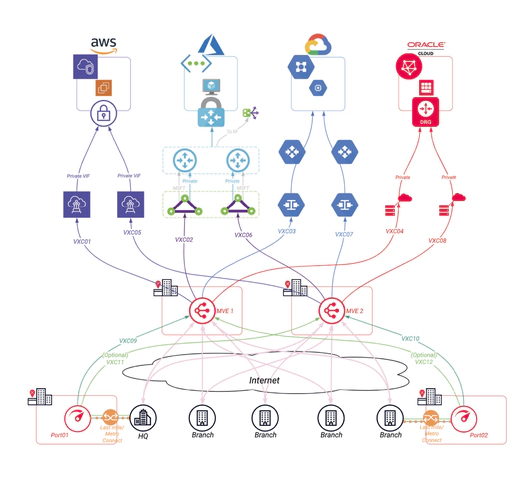
These network setups provide teams with options when something fails. If a port, virtual connection, data center, cloud on-ramp, or branch path becomes unavailable, traffic can be designed to move through an alternate path rather than relying on a single fragile route.
How Brevo built a more resilient SaaS network with Megaport
Brevo, a global SaaS company, needed a more resilient way to support high-bandwidth traffic, cloud-to-cloud connectivity, and ongoing growth. Its team wanted to move away from physical data center complexity while holding on to the reliability needed to keep its customer engagement platform available during peak periods.
Using Megaport Virtual Edge (MVE), Brevo deployed two virtual routing instances across separate data centers, creating a geo-redundant virtual architecture. This gave Brevo resilient interconnections to cloud service providers and Transit IP providers, reducing single points of failure and providing continuous SaaS availability.
Now, Brevo’s scalable, software-defined network supports low-latency, high-bandwidth peering, automated provisioning through Terraform, and the flexibility to expand or diversify cloud services as the business grows.
Final takeaway
Higher network availability comes from designing for failure before it happens. Start by removing single points of failure, building in physical and geographic diversity, using dynamic routing, improving monitoring, and validating that failover works in the real world. When those pieces come together, network uptime becomes less dependent on luck and more dependent on architecture your team can control.
Building for high availability starts with knowing where you can create diverse paths. Explore the Megaport ecosystem to find data centers, cloud on-ramps, and service providers across our global network.