




How Agentic AI Could Change Global Network Deployment
By Serena Toh, Solutions Architect
From the Alibaba Cloud Apsara Conference stage, here's a look at how Agentic AI, APIs, and NaaS could simplify network deployment and automate routing decisions.
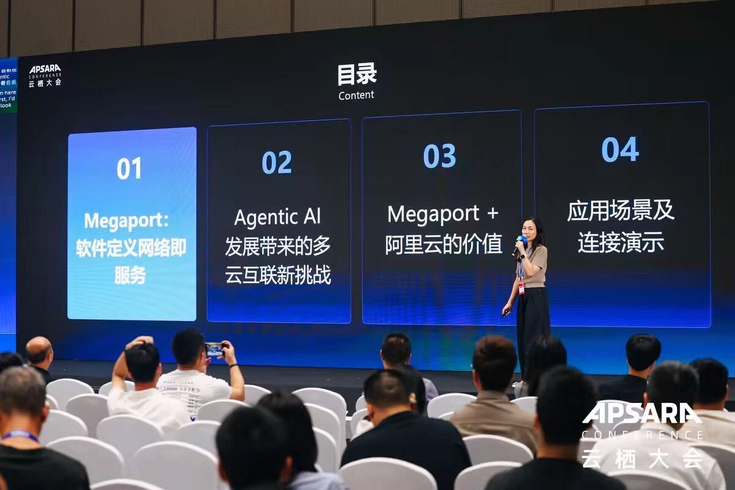
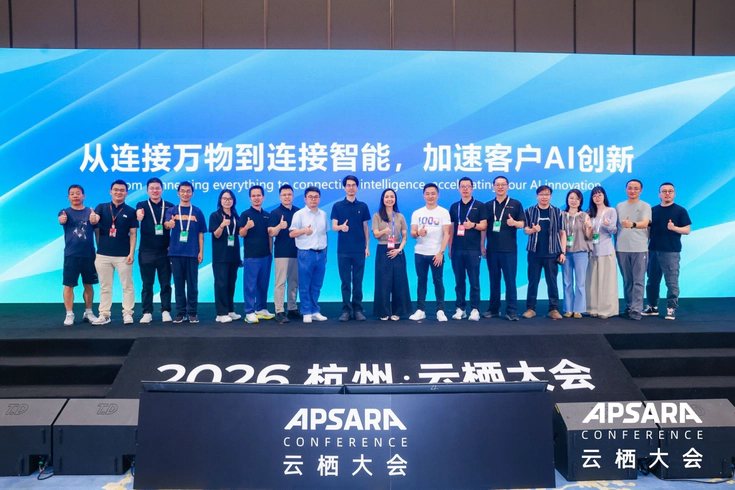
At this year’s Alibaba Cloud Apsara Conference in China, I was honored to represent Megaport on stage to present our live demo session “Alibaba Cloud × Megaport: Making Agentic Networks Simpler”.
During the demo, I showed a real-world scenario using Alibaba’s agentic dev tool, Qoder to demonstrate how agentic AI and NaaS can work together. The user just types one simple natural language prompt, like “I need to connect my data center Equinix PE2 with GPU running to process my data set on Megaport Standard Object Storage urgently" or “Connect from my NTT Singapore Datacentre to Alibaba Cloud Express Connect”.
In just a few seconds, Qoder:
- understands the intent
- checks existing resources via MCP Server and APIs
- sweeps historical RTT latency data
- picks the best on-ramp
- executes the API call to build the VXC (Private Layer 2 Circuit) and routing.
Everything is done and verified on the spot.
After the talk, people couldn’t help but ask, “Serena, was that real or fake? Was just this a pre-scripted demo, or the actual future of network ops?” But it is the latter.
Three reflections I had while prepping my talk
A few weeks back when I started prepping for the live demo, I kept asking myself if network engineers and cloud architects are really ready for agentic AI or not. As a Solutions Architect, this led me to reflect on three insights.
1. AI’s bottleneck often isn’t the brain, it’s the hands and nervous system
LLMs are highly capable, but they’re still limited to giving advice; recommending an architecture without being able to interact with the underlying infrastructure. Megaport’s on-demand network, compute, and storage combined with API-first architecture can provide the “hands and nervous system” that enable Agentic AI to act on infrastructure. When data centers, cloud on-ramps, and Alibaba Cloud Express Connect connections can be defined and managed through code, an AI agent can turn reasoning into action.
2. Building agentic skills is about teaching AI how to make architectural decisions
When we used Qoder to load and run the Megaport skill, the most interesting challenge was making sure the agent respects actual network rules.
For example, we shared commands like:
- Cannot choose any bandwidth; must check current capacity first.
- Cannot simply randomly select endpoints; must hit APIs to check historical RTT latency.
- Must present a proper preview for human confirmation before executing the final purchase.
This made me realize that future Solutions Architect or Network Engineer roles won’t be about manually typing CLI commands or tagging VLANs, but translating architectural best practices into agentic skills and guardrails.
3. The “build locally, connect globally” multicloud era is accelerating
Alibaba Cloud provides enterprises with compute, storage, and AI services across China and the broader APAC region, while Megaport extends those environments globally with neutral, on-demand infrastructure across compute, network, and storage. Now, as AI adoption booms, multicloud environments and distributed GPU clusters are becoming more dynamic.
Waiting weeks for private connectivity to be provisioned no longer matches the pace of modern infrastructure. Dynamic compute needs a network that can adapt just as quickly.
Prepping for this presentation was stressful, but also exciting. Watching a single line of prompt turn into a live, fully provisioned private circuit in seconds with all the right parameters defined confirms agentic networking isn’t just hype anymore — it’s an actual infrastructure revolution happening right now.
Thank you to the Alibaba Cloud team for the invitation and support, and to our Megaport team for building such a solid API ecosystem!
If you’re keen on discussing Agentic AI, Qoder skill dev, or multicloud elastic connectivity, please reach out to me!
Connect on LinkedIn
This blog was originally written in Chinese. Read the original below.
在今年的阿里云云栖大会(Apsara Conference)上,我很荣幸代表 Megaport 站上舞台,分享主题:《阿里云 × Megaport : 让 Agentic Network 更简单》。
现场演示时,我展示了一段业务场景:
当用户输入一句自然语言指令:
“我需要将 Equinix PE2 的 GPU 算力紧急连接到最低延迟的对象存储服务” 或是 “将我在新加坡NTT機房的端口与阿里云 Express Connect 互联”。
AI Agent(Qoder)在几秒钟内理解意图、通过 MCP Server 与 API 查询现存资源、精准比对历史 RTT 延迟矩阵、自动决定最优路径,并调用 API 下发 VXC 二层专线的部署与路由配置,最终完成验证。
台下许多同行问我:“这到底是预录好的脚本,还是未来的日常?
准备这场演讲时,作为方案架构师的 3 个实践反思:
在几个月前开始筹备材料与演示时,我一直在思考:“网络工程师与云架构师,真的准备好迎接 Agentic AI 了吗?”
1. AI 的瓶颈往往不在大脑,而在“双手与神經系統(网络骨干)”
大语言模型很聪明,但如果它说得出方案、却碰不到基础设施,就只是个“动口不动手的顾问”。Megaport 过去十多年建立的 Software-Defined Network (NaaS) 与 100% API-first 架构,恰好成为了 Agentic AI 落地现实世界的“双手与神經系統”。当全球 1,200+ 数据中心、325+ 云接入点(Cloud Onramps)与阿里云专线都可以被代码定义时,Agent 才能真正把推理化为动作。
2. 打造智能体技能(Agentic Skill)不是写死 Prompt,而是教 AI 做架构决策
这次我们使用 Qoder(阿里巴巴的 Agentic 开发工具)来加载与运行 Megaport 技能,最有趣的挑战在于“如何让 Agent 理解网络的约束条件”:
- 它不能盲目开通带宽,必须先查询当前带宽容量;
- 它不能随机挑选节点,必须懂得调用 API 比对过去整个月的 RTT 延迟数据;
- 它必须在最终下单前,以结构化的方式向人类确认。
- 这让我深刻体会到:未来方案架构师的工作不是去手动配置 CLI/VLAN,而是把架构的最佳实践(Best Practices)编写成 Agent 可以理解的技能(Skills)与安全防护栏(Guardrails)。
3. “本地构建,全球连接”的多云时代正在加速
阿里云为企业在本地与亚太提供了极其坚实的计算、存储与通义大模型生态;而 Megaport 则扮演中立延伸的全球动脉。当多云架构(Multicloud)与分布式 GPU 集群因 AI 爆发而变得极其动态时,传统“提工单、等几周”的专线开通模式彻底失效了。动态算力,需要的是同等动态的弹性网络。
准备这次演讲的过程既兴奋又充满挑战。但当看到文字指令化为实时打通的云专线时,我确信:Agentic Network 不是概念,而是正在发生的基础设施革命。
非常感谢阿里云团队的全力支持与邀请,也感谢 Megaport 团队在背后构建出如此稳定强大的 API 生态!
如果你也对 Agentic AI、Qoder 技能开发、或多云弹性互联架构感兴趣,欢迎在下方留言或私信交流!