






A Guide to DDoS Protection in Your Network
- Cloud networking
- August 12, 2026
- RSS Feed
By Randy Riggs, Network and Cloud Solutions Architect
Learn how DDoS attacks work, how threats are evolving, and how modern network-integrated protection can help defend your infrastructure.
Network connectivity is the frontline of revenue generation and customer trust for almost every modern enterprise. But as digital footprints expand across hybrid and multicloud environments, Distributed Denial of Service (DDoS) attacks continue to grow in volume, frequency, and sophistication.
Historically, mitigating a massive Layer 3 or Layer 4 network flood required a compromise: Either route your entire network traffic through third-party tunnels that introduce latency, or rely on upstream ISPs to “null-route” (black-hole) the target IP address. The latter option stops the attack, but it also achieves the attacker’s exact goal — taking your critical infrastructure offline.
To survive these modern attacks, organizations must shift from reactionary, disruptive defenses to network-integrated, automated, on-demand protection.
Table of Contents
What is a DDoS attack?
DDoS attackers will remotely control malware-infected, internet-connected devices, mostly computers, known as bots. A group of these bots, known as a botnet, will then be used to do the attack.
The attackers use this botnet to flood a website with fake traffic, all at once. This will overwhelm the website to the point that it slows down, crashes, or becomes completely unreachable to real users. This is done as the botnet sends thousands (or even millions) of requests to the target website’s IP address to overwhelm the server.
What’s even more frustrating is that there’s no simple way to parse these bots from legitimate traffic, as there’s no way to tell them apart.
Even when DDoS attacks don’t necessarily compromise a company’s sensitive information (although they can certainly lead to that), they can still be highly damaging to a company’s reputation, operations, and bottom line.
People may orchestrate DDoS attacks:
- to take down a competitor’s site, especially at an important moment like a launch
- as a form of protest or revenge on the company
- to distract from another cyberattack
- just for fun (unfortunately).
If the website team doesn’t notice the massively inflated traffic numbers, they will start to realise it once complaints of sites become slow or unavailable altogether. But getting to that point is far from ideal, when a company is already dealing with lost revenue and disgruntled customers. And even then, these inflated numbers don’t always mean a DDoS attack. We’ll look more at how to identify a DDoS attack and tell it apart from others later.
If your website team doesn’t spot the unusually high traffic numbers, you may first realize something is wrong when customers report that your site has slowed down or become unavailable altogether. But by that point, you may have already lost revenue and frustrated many of your customers.
Even then, a sudden spike in traffic doesn’t necessarily mean you’re dealing with a DDoS attack. Shortly, we’ll look at how to identify the signs of a DDoS attack and distinguish it from other issues.
How have DDoS attacks evolved?
According to Cloudflare, DDoS attacks continue to rise. In the first quarter of 2025, the web application security giant blocked 20.5 million DDoS attacks, almost as many as it blocked in the entire year of 2024 (21.3 million). The most significant increase was in network-layer DDoS attacks, which rose 509% year over year.
Attacks are also becoming more intense. Cloudflare blocked more than 700 hyper-volumetric attacks exceeding 1 Tbps or 1 billion packets per second (Bpps) during the quarter, averaging around eight per day. At the same time, many attacks are over remarkably quickly: 89% of Layer 3/4 DDoS attacks observed by Cloudflare ended within ten minutes.
This combination of greater volume and shorter attack windows makes rapid detection and automated mitigation increasingly important. An attack may be largely over by the time a team has identified it and begun responding manually.
Types of DDoS attacks
Because network connections consist of several layers, DDoS attacks can take many forms (too many to list here). But here are a key few to be aware of:
Volumetric attack
Also known as a volume-based attack, volumetric attacks are what most people are thinking of when they picture a DDoS attack — referring to botnets overwhelming a network’s bandwidth to prevent legitimate users from accessing the site.
By causing congestion on a site to the point it becomes unresponsive, attackers will often count on the disabling of a firewall or similar traffic monitor so they can infiltrate your network, infect it with malware, and steal sensitive data.
Protocol attack
A SYN flood overwhelms a web server’s connection queue by initiating the TCP three-way handshake but leaving the connection half-open. A “ping of death” attack, meanwhile, can crash vulnerable operating systems by sending fragmented, oversized packets that exceed the maximum allowed IP packet size. Another protocol-based attack, known as a Smurf attack, amplifies traffic by exploiting network broadcast addresses and causing multiple devices to respond to a forged IP address.
Application layer attack
An HTTP flood takes down websites by generating thousands of complex page requests that mimic legitimate web browser traffic. Similarly, a “slowloris attack” disables web servers by opening multiple communication lines and holding them open indefinitely with slow, incomplete data transfers.
Why traditional DDoS defences aren’t keeping up
When combined with the growing sophistication of attacks, traditional approaches to DDoS protection have left several gaps in the current cybersecurity landscape.
- BGP tunneling and latency: Diverting traffic via GRE tunnels or public internet paths to remote, third-party scrubbing centers adds routing hops, driving up latency and degrading application performance for legitimate users.
- The “all-or-nothing” penalty: Standard ISP black-holing lacks the level of detail needed to isolate a specific compromised host, accidentally knocking out neighboring clean services on the same subnet.
- Predictability pitfalls: Many security vendors use a variable, attack-volume pricing model that penalizes enterprises financially when they are targeted by massive volumetric attacks, making budgets highly unpredictable.
- Target shift: DDoS is no longer just for large enterprises. Smaller enterprises in retail, financial services, education and similar industries are seeing higher levels of attacks, but may feel left behind or unsure how to leverage their resources to protect their operations.
- Higher costs of downtime: As more enterprises are using the internet for more services, including networking services like SD-WAN, it can consume a larger portion of revenue than for larger enterprises. Also there is an increased risk of repeat attacks when initial vulnerabilities are discovered.
How have modern DDoS attack techniques changed?
Legacy defense systems haven’t kept up with major shifts in modern attacker behavior:
“Hit-and-run” short-burst attacks
Threat actors have shifted from prolonged digital sieges to high-intensity, high-volume bursts often lasting under five minutes. Because legacy systems rely on slow BGP route redirections or manual human intervention, the attack has often finished and caused its damage before traditional mitigation can even activate.
These attacks also pause frequently, giving responders a false sense of security only to resume again — causing confusion and panic.
Carpet bombing subnet attacks
Rather than flooding a single IP address, attackers now frequently distribute smaller, concurrent traffic bursts across an entire subnet range. This method effectively bypasses traditional legacy per-IP threshold detectors, while the cumulative traffic still completely saturates aggregate network links.
Asymmetric threat economics
The cost barrier to launching a massive multi-gigabit attack via automated botnets has dropped to pennies, while network downtime for unprotected enterprises remains financially devastating. Metered security models amplify this risk by charging enterprises based on attack volume, financially penalizing businesses for being targeted.
Mimicking human behavior
Sophisticated bots convincingly imitate legitimate user behavior to bypass security filters. Instead of flooding servers with blunt traffic, these bots navigate sites with realistic delays, rotate valid session cookies, and mimic geographic headers matched to the target’s customer base. By executing resource-heavy actions like API searches or checkout flows rather than loading static homepages, they slip past conventional rate-limiting systems unnoticed.
Automated botnet swarms
This type of attack increases attack stealth and velocity by dynamically routing malicious traffic through millions of compromised residential IP addresses and IoT devices, effectively blending in with legitimate regional users. Controlled by decentralized command structures, these swarms orchestrate massive parallel attacks that can instantly exploit newly discovered zero-day protocol vulnerabilities before organizations can deploy global patches.
By constantly rotating their source signatures and behaviors in real time, these automated networks make traditional IP-reputation blocklists and static firewall rules completely obsolete.
How network-integrated DDoS protection prevents DDoS attacks
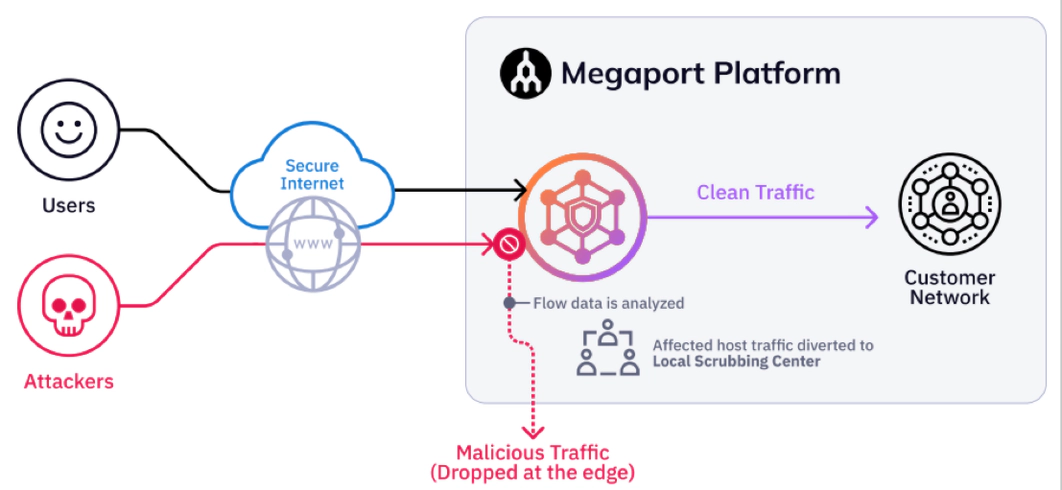
Network providers deliver comprehensive DDoS protection through a combination of rapid detection, strategic traffic routing, and advanced filtering. By placing dedicated scrubbing architectures right where internet traffic enters the regional network border, network-integrated DDoS can intercept threats before they ever reach your perimeter.
1. Rapid detection
Modern network perimeters utilize continuous, passive flow sampling to monitor traffic without degrading performance. By analyzing metrics against industry-specific baseline templates, the system instantly identifies volumetric and protocol anomalies. This automated detection removes manual rule-tuning, flagging zero-day signatures and activating alerts the moment a threat crosses your network border.
2. Strategic traffic routing
Upon threat confirmation, the network dynamically shifts its routing logic to neutralize the threat. This process unfolds across two distinct operational phases:
Phase 1: baseline operation (passive mode)
Under standard operating conditions, all inbound traffic travels along the most direct network path through the provider’s cloud to your router. Because the scrubbing infrastructure is completely bypassed when there is no active threat, traffic takes the fastest path with no latency penalty. Meanwhile, the network continuously runs passive flow sampling to maintain a security baseline without interrupting delivery.
Phase 2: active attack (active mode)
The moment an attack is confirmed, the network dynamically injects a surgical /32 host route to isolate only the IP address targeted by the attack. Traffic bound for that specific target is instantly diverted to an internal, network-integrated scrubbing center.
Crucially, traffic destined for all other unaffected hosts on your subnet continues to bypass the scrubbing path entirely, remaining insulated from routing updates or localized latency shifts.
3. Advanced filtering
Once traffic is diverted during a Phase 2 event, it undergoes granular protocol and network-layer mitigation at the scrubbing center to strip away malicious packets. Sophisticated filtering mechanisms systematically drop high-volume exploits (e.g. SYN, UDP, DNS/NTP amplification floods) while surgically extracting legitimate user traffic.
Clean, verified packets are then seamlessly merged back into the provider backbone and forwarded safely to the customer’s router.
Why use Megaport for DDoS protection?
Mitigating complex network threats shouldn’t require complex procurement cycles. For organizations using Megaport Internet, enterprise-grade DDoS protection is now available as a native, zero-hardware add-on directly within the Megaport Portal and API ecosystem.
The onboarding workflow is built for immediate, self-service execution.
Frictionless activation and BGP transparency
Within the Megaport Portal, users can attach DDoS Protection to any new or existing Megaport Internet service, select their clean traffic capacity, and pick from six to eight plain-language industry profiles optimized for their specific workload.
For multi-homed BGP environments, the platform provides explicit routing transparency up front: Protection covers all traffic transiting the Megaport network, keeping boundary expectations clear for multi-provider topologies.
Granular dashboard control
Once provisioned, the service defaults to Monitoring Mode to baseline traffic safely. From a single dashboard, network teams gain a dedicated view to:
- instantly toggle between passive monitoring mode and active protecting mode
- analyze real-time time-series graphs of clean versus scrubbed traffic volumes
- flag false positives to dynamically tune the underlying mitigation engine.
Proactive DDoS insights
To ensure continuous perimeter visibility, Megaport surfaces passive threat anomalies directly within its standard internet service view. Operations teams can access clear, real-time data on hidden vulnerabilities before they escalate into disruptive events.
DevOps-ready automation
Thanks to Megaport’s software-defined core, every feature available in the portal — from profile adjustments and notification webhooks to historical attack data retrieval — is completely exposed via the Megaport API for automated security orchestration.
By coupling high-capacity regional scrubbing centers with a clean, API-first management layer, Megaport removes the complexity of traditional DDoS platforms, instead providing instant perimeter defense, flat capacity pricing, and complete control over your network resilience.
Case study: RedShield
RedShield provides web application shielding that helps global enterprises and governments prevent vulnerabilities without touching source code. A critical part of its mission is protecting clients against DDoS attacks that can cripple performance and expose sensitive data.
To meet growing demand and counter increasingly complex threats, RedShield needed a more robust and flexible network than what traditional internet-based routing could provide, as they found themselves exposed to volumetric attacks and unpredictable latency.
By using Megaport’s NaaS, RedShield established private, low-latency connections between its data centers and cloud environments. By bypassing the public internet, this private connectivity removes a major attack vector for DDoS campaigns.
With Megaport, RedShield can now:
- shield customer traffic from the open internet
- rapidly route traffic away from affected regions or services
- instantly scale connections to absorb unexpected demand spikes.
This network agility allows RedShield to respond in real time and preserve application uptime. By combining intelligent shielding with Megaport’s private connectivity, RedShield delivers faster, safer, and more secure digital experiences for clients worldwide.
Learn more about Megaport DDoS protection, or start building right now in the Megaport Portal.